Battery Impedance Measurement: Giving Incoming Cell Checks a Clearer Method
A delivery of cells arrives with matching labels and a supplier’s test report. Before releasing the batch for development work, the laboratory wants its own incoming check. Voltage readings are useful, but the team also wants an electrical measurement that can help identify samples needing closer examination.
Battery impedance measurement can form part of that process. Its value depends on a defined method: comparable sample conditions, consistent connections and a clear reason for the acceptance limits. The NEWARE BT-9562 is one instrument to consider when building this type of checking routine.
Start by deciding what the result will change
Before measuring the first cell, decide how the result will be used. Will unusual readings trigger a repeat measurement, a separate capacity test or a discussion with the supplier?
That decision keeps the check focused. Collecting numbers without an agreed response can leave operators unsure whether to accept, reject or simply record a sample.
For an incoming batch, a useful first step is to establish the expected behaviour of the relevant cell type under the chosen conditions. Acceptance limits should come from the organisation’s qualification work or an agreed specification, rather than an arbitrary threshold applied to every battery.
Know which measurement the instrument performs
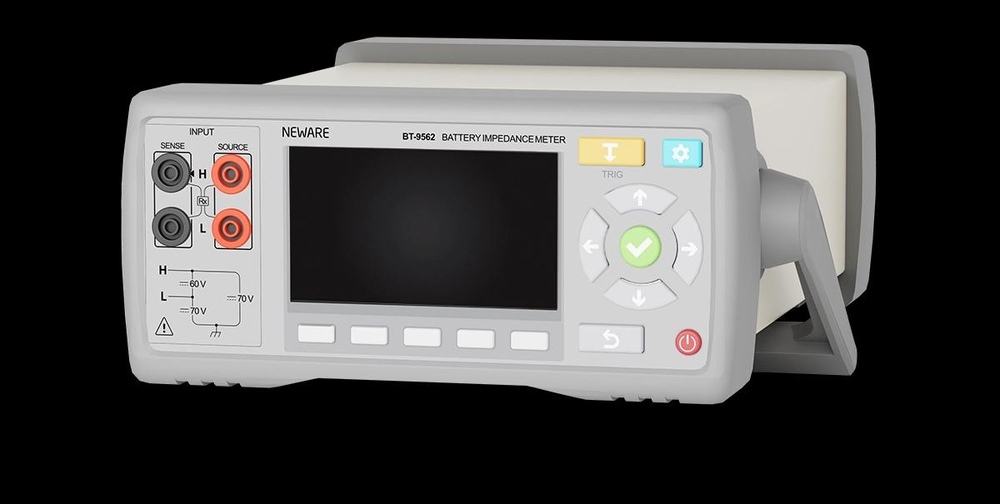
The NEWARE BT-9562 is designed for battery impedance measurement. The published datasheet specifies an AC four-terminal method at 1 kHz and lists internal resistance, voltage, reactance, complex impedance and phase angle among its measurement functions.
The fixed measurement frequency matters when comparing results. A reading taken with this method should be compared with data obtained under matching conditions. It is not a full impedance spectrum across a range of frequencies.
The datasheet also lists impedance ranges of 3 mΩ, 30 mΩ, 300 mΩ and 3 Ω. Discuss range selection with the supplier using representative cells and the readings expected from your application.
Make repeated measurements comparable
Prepare a short procedure covering sample condition, measurement timing and connection placement. Record the relevant temperature and state-of-charge conditions so a later comparison has context.
Use a consistent contact arrangement. Check that probes or clips reach the intended surfaces and that operators understand how to position them. If a reading is unexpected, inspect the connection and repeat the measurement according to the procedure.
That repeat check can help distinguish a persistent sample result from a measurement affected by handling. Keep both results when the method requires it, rather than replacing the first number without explanation.
Give each reading a sample identity
A measurement becomes more useful when it remains attached to the correct cell. Record the batch, sample identifier, date and applicable method version alongside the result.
For a small trial, this may be a controlled worksheet. A larger operation may need a more structured data flow. The BT-9562 datasheet lists Ethernet, RS-232C and USB interfaces, along with external trigger and sorting-related I/O.
Ask the supplier to demonstrate the intended connection to your existing system. Confirm the output format and how a measurement will be associated with the sample identifier before planning an automated station.
Use unusual results to guide the next check
When one cell differs from the rest, review its measurement conditions and repeatability before making a decision. A consistent difference may justify further investigation through the laboratory’s agreed process.
Impedance results add information to incoming checks, while capacity and other performance tests answer different questions. The acceptance procedure should explain how those results work together.
The NEWARE BT-9562 is worth evaluating when its measurement method and ranges match the application. With a clear procedure and traceable records, battery impedance measurement can give a team a practical way to flag samples for closer attention.
Image credit: NEWARE BT-9562 official datasheet; product image for reference.
Neware BTS
.