Explosion Proof Mini IR Camera for UK Tank Farms
The Buncefield fuel storage depot explosion of 2005 caused £1 billion in damage and remains the largest peacetime explosion in the UK since the Second World War. The incident began with an overflowing storage tank — a failure of level monitoring, but one that a thermal imaging system would have flagged through the temperature differential between a tank filling with cold fuel and its warming neighbours. Fuel storage is inherently one of the highest-risk operating environments in the country. The thermal dynamics of tanks, transfer pumps, loading arms, and pipeline networks produce continuous data that, correctly monitored, enables early-warning intervention before a hazardous condition develops into an incident.
Thermal Hazards in Fuel Storage: What You Are Actually Monitoring
Fuel storage facilities carry risk across multiple thermal pathways simultaneously. Understanding which pathways require monitoring — and where cameras should be positioned to capture them — is the starting point for any effective thermal surveillance strategy.
The principal thermal risks in a UK tank farm environment include heat accumulation in product during summer loading cycles, which can approach or exceed the flashpoint of lighter petroleum products stored in above-ground tanks. Pump mechanical seals running hot signal impending seal failure, the precursor to product release and potential ignition at the pump deck. Transfer line lagging damage exposes pipe surfaces to ambient heat that can, in certain product types, contribute to vapour generation. Electrical trace heating systems malfunctioning on heating-assisted products can produce localised overtemperature conditions within the insulation layer, invisible to routine inspection.
All of these hazard types produce infrared signatures detectable through continuous thermal monitoring. None of them reliably produce visible symptoms — smoke, flame, or audible alarm — until the hazard has already escalated beyond the early-intervention window.
For major fuel terminals on the Thames Estuary, the Humber port cluster, and the independent storage facilities serving the South West and Scotland’s central belt, these risk types are present simultaneously and continuously. Your monitoring architecture needs to match that profile.
Monitoring Tanks, Pumps, and Transfer Systems: Key Use Cases
Fixed infrared camera deployment across a tank farm addresses five core monitoring use cases, each of which delivers independent operational value:
Tank roof and shell temperature monitoring — floating roof tanks expand and contract with product level and ambient temperature. Abnormal temperature distribution across the tank shell — a cold band at a consistent level, or localised heat concentrating at a seal — signals a condition worth investigating. Thermal imaging across the tank population from fixed elevated camera positions provides that picture continuously.
Pump deck thermal surveillance — mechanical seal overheating at product transfer pumps is both a maintenance indicator and a fire risk precursor. A fixed infrared camera covering the pump deck detects seal housing temperature trends and alerts your operations team before a seal fails and product is released to atmosphere.
Loading arm and gantry monitoring — product transfer at road and rail loading gantries involves temporary connections between fixed infrastructure and mobile assets. Thermal imaging covering the loading bay detects product temperature anomalies, overfill risk indicators, and electrical heating system faults within the loading structure.
Pipeline and manifold thermal profiling — above-ground sections of the pipeline network connecting tanks to loading points are subject to solar heat gain, lagging degradation, and flow-induced temperature variation. Infrared monitoring of exposed pipeline sections identifies hotspots that indicate lagging failure or product condition change.
Perimeter and bund area surveillance — bunded containment areas surrounding storage tanks are classified hazardous zones under DSEAR. Thermal monitoring within bunded areas detects product spills through the temperature differential between released fuel and the concrete bund floor, providing an earlier alert than liquid-level sensors in some low-volume release scenarios.
An Explosion proof Mini IR Camera deployed for any of these use cases within a DSEAR-classified zone must carry the appropriate ATEX Equipment Category certification. Tank farms are typically classified as Zone 1 around tank vents and dip hatches, and Zone 2 across the wider bunded area — both designations require certified explosion-proof equipment.
Installation Recommendations for Tank Farm Environments
Tank farms present specific installation challenges. The open-air environment exposes equipment to the full range of UK weather conditions — temperature cycling, precipitation, salt-laden coastal air at terminal sites, and wind loading on elevated mounting positions. Camera housings must be rated for sustained outdoor exposure without ingress or corrosion degradation.
A Compact Explosion Proof Mini IR Camera with a weatherproof and corrosion-resistant housing is suited to both elevated gantry mounting — giving a wide-angle thermal view across a tank population — and low-level positioning at pump deck height for close-range seal monitoring. Its compact form factor reduces wind loading on elevated mounts and simplifies the bracket engineering that fixed elevated positions require.
Cable routing at tank farms must be planned carefully. All cable entries into classified zones require Ex-certified cable glands appropriate to the zone category. An explosion proof mini IR camera ATEX Zone 1 UK certified installation that uses non-Ex-rated glands at the zone boundary fails compliance regardless of the camera’s own certification status. Your installation specification should address cable routing, gland selection, and junction box certification as explicitly as it addresses camera selection.
SharpEagle’s Camera: Engineered for Fuel Storage Monitoring
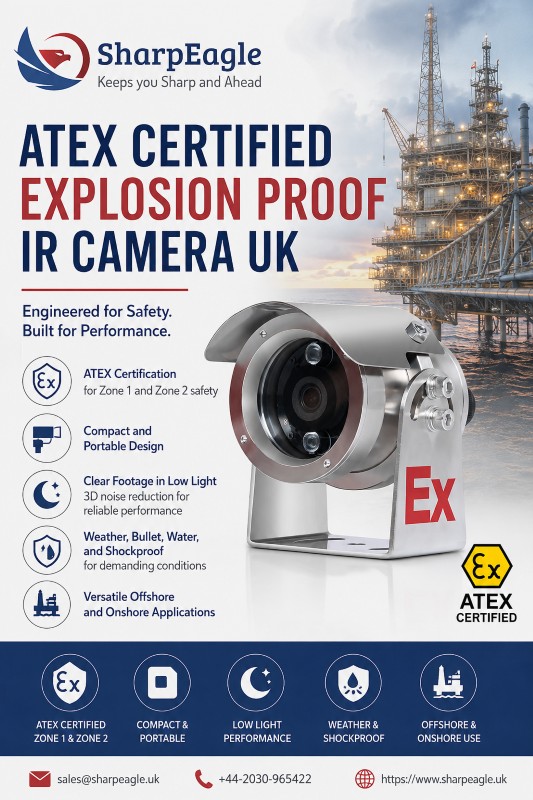
SharpEagle Technology’s Explosion proof IR Mini Camera addresses the specific environmental and compliance demands of UK tank farm and fuel storage facility deployment. ATEX and IECEx dual certified for Zone 1 and Zone 2, it provides the certification foundation required across the full range of classified zone designations within a typical tank farm layout.
Key features relevant to fuel storage monitoring:
ATEX and IECEx dual certification, meeting DSEAR equipment selection requirements for both Zone 1 and Zone 2 classified areas within a tank farm boundary
Weatherproof, water, shock, and corrosion-resistant construction for sustained outdoor operation in the UK coastal and inland terminal environments where fuel storage facilities are commonly located
1080p HD imaging with 3D noise reduction providing clear thermal image quality across the extended field-of-view ranges required to monitor tank shell surfaces and pump decks from elevated fixed positions
Compact and lightweight housing reducing wind loading on elevated mounting structures and simplifying gantry installation without structural reinforcement
IP/PoE and analogue output variants for integration with site SCADA systems, terminal management platforms, and emergency shutdown system monitoring interfaces
As a Mini Explosion proof Camera built for 24/7 continuous outdoor operation, it sustains reliable performance across the seasonal temperature range, precipitation exposure, and UV degradation conditions that above-ground installation at a UK fuel terminal imposes over a multi-year deployment lifecycle.
Sourcing from an explosion proof mini IR camera supplier UK based ensures that post-installation technical support and ATEX conformity documentation are available within the UK regulatory framework — relevant when your HSE site inspection requires evidence of supplier compliance credentials alongside your equipment certification records.
Reducing Operational Risk Through Continuous Thermal Monitoring
The operational risk reduction case for thermal camera deployment at UK fuel storage facilities is not theoretical. It is a direct function of detection speed: the earlier a thermal anomaly is identified and acted upon, the smaller the consequence of the underlying event. A pump seal overheating identified through a camera alert triggers a maintenance call-out. The same seal failing undetected triggers product release, potential ignition, and an HSE-reportable incident.
Your risk assessment under DSEAR should consider continuous thermal monitoring as a control measure proportionate to the ignition risk profile of a fuel storage environment. It is not a substitute for gas detection, level monitoring, or fixed fire suppression systems — but as a layer of the defence-in-depth strategy that UK tank farm operators are expected to demonstrate, it closes a monitoring gap that no other technology addresses as effectively.
Conclusion
Tank farms and fuel storage facilities represent some of the highest consequence risk environments in UK industry. The regulatory framework under DSEAR and HSE workplace safety standards is clear about the obligation to prevent fire and explosion — and thermal monitoring is increasingly recognised as a fundamental component of a credible prevention strategy, not an optional enhancement. As UK fuel storage operators face greater regulatory scrutiny and insurer pressure to demonstrate proactive hazard management, the case for continuous certified thermal imaging across classified zones has never been stronger. To specify the right explosion proof mini IR camera for hazardous area UK fuel storage deployment, contact SharpEagle Technology for a site-tailored assessment and compliance consultation.
About SharpEagle Technology
SharpEagle Technology is a leading provider of industrial safety solutions specializing in forklift safety systems, explosion-proof surveillance cameras, and AI-powered monitoring technologies for warehouses, logistics, manufacturing, and high-risk industrial sectors.
For more information, visit: https://www.sharpeagle.uk
SharpEagle Technology
.