How Packaging Design Influences Food Safety and Consumer Trust
A food package can look perfectly fine on a store shelf and still fail at its most important job. A weak seal, unsuitable coating, damaged closure, or incorrect material can expose the product to conditions that affect its quality and safety. These problems are not always visible when a customer first picks up the package.
This is why food packaging design deserves more attention than its appearance usually receives. The material, structure, closure, printing, and labeling all influence how well a product is protected from production through delivery and storage. They also shape how customers judge the business behind it. A package that performs reliably gives consumers a practical reason to feel confident about what they are buying.
1. Why Food Packaging Matters Beyond Appearance
Packaging is part of a food product’s protection system. Its first responsibility is to create a suitable barrier between the food and its surroundings. Depending on the product, this may involve limiting exposure to moisture, oxygen, light, dust, handling, or other sources of contamination.
Consider a bakery selling fresh cookies. A well-designed carton can prevent the cookies from being crushed, while an appropriate inner liner can help manage moisture and grease. If the box is too large, the contents may move around during delivery. If the closure is unreliable, the package may open before reaching the customer.
The same principle applies to packaged meals, frozen foods, dairy products, snacks, and beverages. Each product has different storage and handling requirements. A packaging format that works well for one food category may be unsuitable for another.
Appearance still matters, particularly in retail environments where customers make quick purchasing decisions. However, attractive printing cannot compensate for poor sealing, weak construction, or an unsuitable food-contact material. The strongest packaging decisions begin with product requirements and use appearance to support them.
2. How Packaging Materials Affect Food Safety
Choosing food packaging materials involves more than comparing price, thickness, or appearance. A material must be suitable for the particular food, its temperature, its storage conditions, and the way the package will be used.
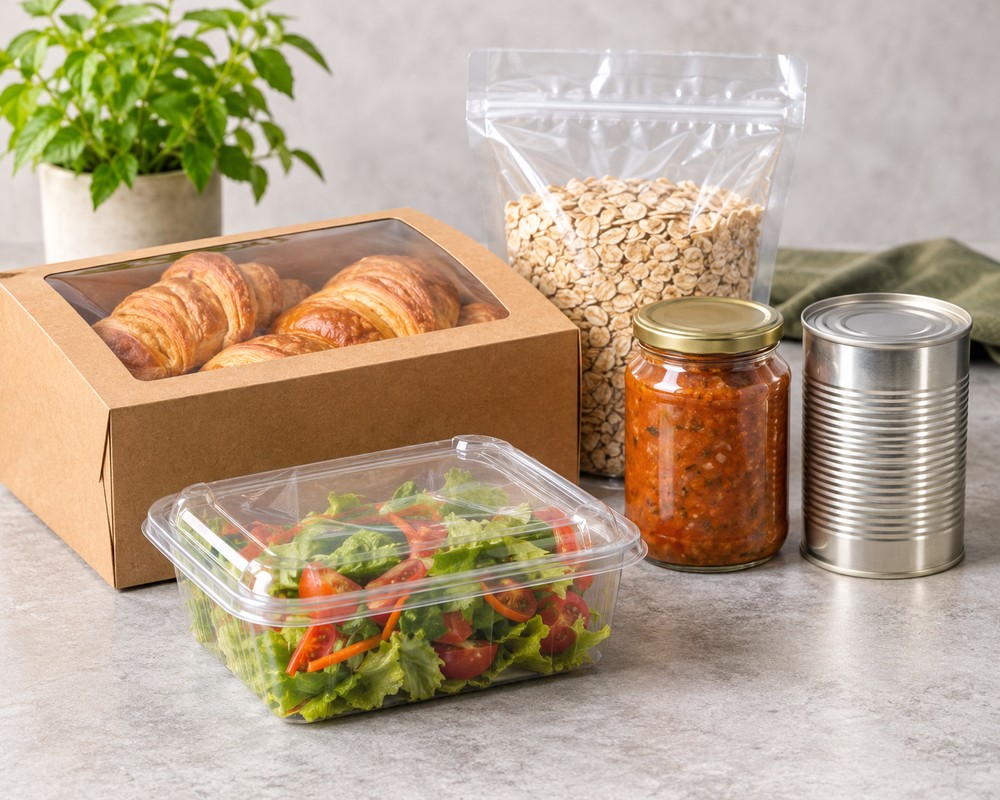
Paperboard, plastics, glass, and metal each offer different characteristics.
Paperboard and cardboard
Paperboard is widely used for bakery products, dry foods, takeaway meals, and retail cartons. It offers good structural possibilities and provides a useful surface for printing product information and branding.
However, ordinary paperboard is not automatically suitable for direct food contact. Grease, moisture, and liquid foods may require an appropriate barrier or liner. Any coating, adhesive, or other component used in the construction must also be suitable for its intended application.
Plastic packaging
Plastic is used in flexible pouches, trays, bottles, films, and containers. Different polymers provide different levels of flexibility, strength, moisture resistance, and oxygen protection.
The important question is not simply whether a plastic is food-grade. Businesses should confirm that the specific material and its intended conditions of use are appropriate. Temperature, food composition, contact time, and the possibility of chemical migration all matter.
Glass and metal
Glass provides a strong barrier against gases and moisture and does not normally react with most foods. It is widely used for sauces, beverages, preserves, and other products requiring a rigid container.
Metal packaging, including aluminum and steel cans, can provide excellent protection from light and external contamination. Internal coatings may be needed to ensure compatibility with particular food products.
The U.S. Food and Drug Administration explains that food-contact substances include packaging components, adhesives, colorants, and other substances that may come into contact with food. Their suitability must be considered for the intended conditions of use. Businesses can consult the FDA’s food packaging and food-contact substances guidance when reviewing material choices.
3. The Importance of Moisture and Oxygen Barriers
Moisture and oxygen are two important factors that can affect food quality during storage. Packaging must manage their movement according to the characteristics of the product.
For example, crackers and breakfast cereals need protection from moisture because exposure can reduce crispness. A package that allows too much water vapor to enter may leave the product soft before its printed expiration or best-by date.
Oxygen creates a different challenge. It can contribute to oxidation, which may affect the flavor, color, aroma, and quality of products containing fats and oils. Certain snacks, nuts, and powdered foods may therefore require packaging with stronger oxygen barriers.
Light can also affect some products. Oils, dairy powders, and other light-sensitive foods may benefit from opaque packaging or structures that limit light transmission.
Why barrier specifications matter
Packaging suppliers often discuss oxygen transmission rate (OTR) and water vapor transmission rate (WVTR). These measurements help describe how easily oxygen and water vapor pass through a material under specified test conditions.
However, a barrier figure should never be considered in isolation. Temperature, humidity, film thickness, package construction, and testing methods can influence the result.
A material that performs well in a laboratory test may behave differently after being folded, sealed, transported, or exposed to changing temperatures. For this reason, manufacturers should evaluate the complete package rather than relying exclusively on a material specification.
A useful technical resource on this subject is Packaging-Industry.info’s guide to flexible packaging barrier specifications.
4. How Packaging Design Protects Food During Transportation
Food packaging does not remain in one place. After production, it may pass through warehouses, distribution centers, delivery vehicles, retail storage areas, and customer handling.
Each stage introduces potential risks. Packages can be dropped, compressed, exposed to humidity, or moved repeatedly. A container that performs well on a production line may not provide enough protection under real distribution conditions.
Structural design plays an important role here.
A takeaway meal box, for example, should hold its shape when filled and carried. Its base must support the weight of the food, while its closure should remain secure during normal handling. If the container allows sauce to escape, the contents may become contaminated or create an unpleasant delivery experience.
For products sold in multiple units, secondary packaging also matters. Cartons and shipping cases should prevent excessive movement and provide sufficient stacking strength. Internal dividers can be useful for glass containers or fragile products.
Businesses should test packaging with the actual product rather than relying only on empty samples. A practical trial can reveal problems with leakage, compression, fit, handling, and closure performance before a large production order is placed.
Companies reviewing professional custom packaging solutions from BoxyPack should approach the selection process with these functional requirements in mind, rather than treating packaging as a printing decision alone.
5. Why Proper Food Labeling Matters
A package may protect its contents physically, but its label communicates important information to the person buying or consuming the food.
Incorrect, incomplete, or difficult-to-read labeling can create confusion and, in some circumstances, serious safety concerns.
Food labels commonly provide information such as:
• Product name and description.
• Ingredient list.
• Allergen declarations.
• Net quantity.
• Nutrition information where required.
• Storage and handling instructions.
• Manufacturer or distributor details.
• Date marking and applicable lot identification.
Allergen information deserves particular attention. A customer with a food allergy may depend on the ingredient and allergen information printed on the package when deciding whether a product is safe to consume.
Legibility also matters. Very small text, poor color contrast, crowded layouts, or information placed near folds and seals can make important details difficult to read.
The design team should consider the label during the structural development stage. Leaving too little space for mandatory information can result in last-minute artwork changes or compromised readability.
Requirements vary by market and food category, so businesses should verify the applicable labeling regulations before printing. Packaging artwork should be reviewed as part of product compliance, not treated as a purely creative task.
6. Food Packaging and Consumer Trust
Consumers cannot usually inspect a product’s manufacturing environment or test its packaging material before making a purchase. They rely on visible information and the condition of the package to make judgments about quality and safety.
A clean, intact package with readable information creates a better first impression than one with damaged corners, leaking contents, or unclear labeling.
Packaging design and consumer trust are also connected through consistency. If a customer repeatedly receives products in properly sealed, undamaged packaging, the business demonstrates that it takes product handling seriously.
Tamper-evident features can provide another layer of reassurance. Depending on the product, these may include breakable seals, induction seals, tear strips, or closures that visibly indicate whether a package has been opened.
However, businesses should avoid making claims that their packaging cannot support. A tamper-evident closure does not automatically mean a product is sterile or free from every possible contamination risk. Its purpose is to provide evidence of interference under the conditions for which it was designed.
Branding can reinforce trust when it is supported by actual performance. A well-designed food box with clear product information, suitable materials, and reliable construction sends a more convincing message than expensive printing alone.
7. Common Packaging Mistakes Food Businesses Should Avoid
Some packaging problems develop because businesses focus on one requirement while overlooking others. These mistakes can increase waste, damage products, and weaken customer confidence.
Choosing materials based only on price
A cheaper material may reduce the initial packaging cost but create higher expenses through damaged products, rejected deliveries, or shorter shelf life. Material selection should consider total performance, not just purchase price.
Using the same packaging for different foods
Dry snacks, oily meals, chilled desserts, and frozen products have different requirements. Using one generic container across all categories can result in unsuitable moisture control, poor structural performance, or inadequate temperature compatibility.
Ignoring seals and closures
A package may have excellent material properties but still fail at its weakest point. Contaminated sealing surfaces, incorrect sealing temperatures, or poor closure design can create leakage and reduce package integrity.
Overlooking printing and label placement
Artwork should not cover important product information or interfere with functional areas such as seals, folds, and opening instructions. Packaging should be checked in its assembled form, not only as a flat design file.
Skipping real-world testing
A sample that looks good on a computer screen or showroom table has not necessarily been tested under actual conditions. Businesses should evaluate filled packages, transport performance, storage behavior, and sealing reliability before approving full production.
8. How Businesses Can Make Better Packaging Decisions
A reliable packaging decision begins with understanding the product. Before choosing a material or design, manufacturers should identify the food’s moisture content, fat content, sensitivity to oxygen and light, storage temperature, and intended shelf life.
They should also consider the journey from filling to consumption. A product intended for local takeaway delivery has different handling requirements from one that will spend several weeks in a distribution network.
A practical evaluation process can include the following steps:
1. Define product requirements: Identify the food’s physical characteristics, storage conditions, and expected shelf life.
2. Review material suitability: Confirm that all food-contact materials, coatings, inks, and adhesives are appropriate for the intended application.
3. Set performance specifications: Establish requirements for barrier properties, package strength, leakage resistance, and closure integrity.
4. Develop a suitable structure: Choose a format that protects the food and remains practical for filling, storage, transportation, and use.
5. Test actual samples: Evaluate filled packages under realistic handling and storage conditions.
6. Review labeling: Check mandatory information, allergen declarations, readability, and relevant market requirements.
7. Monitor performance: Collect feedback from customers, retailers, distributors, and production teams to identify recurring packaging problems.
For food brands exploring different carton formats, BoxyPack’s food packaging boxes provide an example of how material, structure, and product presentation can be considered together. The right specification, however, should always be determined by the food and its actual operating conditions.
Businesses selling into the European market should also review the European Commission’s official food contact materials guidance. European requirements address the safety of materials that come into contact with food, including the potential transfer of substances that could affect health or food quality.
Conclusion
Good food packaging should protect the product before it tries to impress the customer. Material suitability, barrier performance, structural strength, secure closures, and accurate labeling all contribute to a package that performs as expected. These decisions also influence how consumers judge a food brand.
Businesses that test their packaging under realistic conditions are better positioned to identify weaknesses before products reach the market. A thoughtful approach to food packaging design can reduce avoidable product damage, support food safety, and create a more consistent customer experience. Trust is built when the package delivers what the product and its label promise.
Alber Khan