Packaging Robotics Market: Trends, Growth Drivers, and What’s Next
Walk into almost any modern distribution center or food processing plant today, and you’ll notice something that would have seemed futuristic a decade ago: robotic arms picking, sorting, palletizing, and sealing boxes with barely any human intervention. This shift isn’t a passing trend — it’s a structural change in how goods get packaged and moved around the world, and it’s happening faster than most industry outsiders realize.
The packaging robotics market sits at the intersection of two massive forces: the relentless growth of e-commerce and the global shortage of manufacturing labor. Together, they’re pushing companies of every size — from small co-packers to multinational consumer goods giants — to rethink how they get products off the line and onto a truck.
What Exactly Is Packaging Robotics?
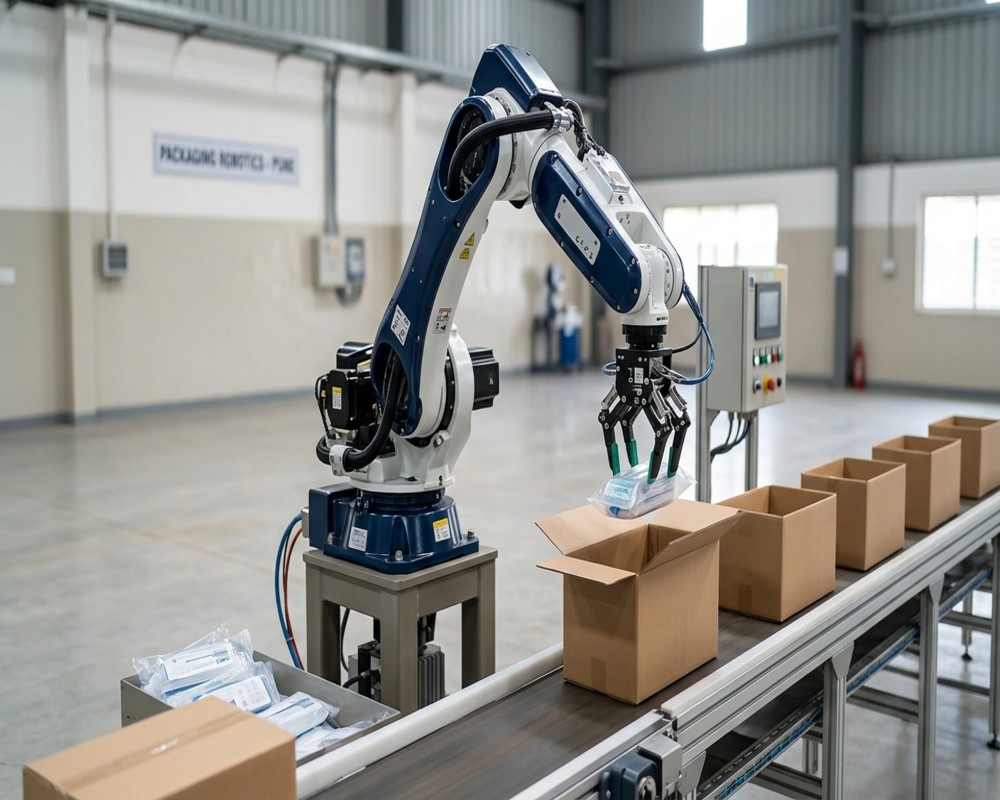
Packaging robotics refers to automated systems — robotic arms, grippers, vision systems, and the software that ties them together — used to perform tasks like picking, placing, packing, palletizing, wrapping, and labeling products. Unlike older, fixed automation (think conveyor belts and mechanical arms that do one repetitive motion forever), today’s packaging robots are increasingly flexible. Many can be reprogrammed in hours, not weeks, to handle new product sizes, seasonal packaging changes, or entirely different SKUs.
The core categories most companies think about when they say “packaging robot” include:
• Pick-and-place robots – used for picking individual items and placing them into boxes, trays, or cases
• Palletizing robots – stacking finished cases or boxes onto pallets for shipping
• Case packing robots – loading products into secondary packaging like cartons or cases
• Wrapping and labeling robots – applying shrink wrap, stretch wrap, or labels at speed
How Big Is the Packaging Robotics Market, Really?
Market sizing in this space varies quite a bit depending on which research firm you ask and how broadly they define “packaging robotics” (some studies fold in adjacent packaging machinery, others focus narrowly on robotic arms and grippers). That said, most industry analyses converge on a few consistent themes:
• The global market has generally been valued somewhere in the low-to-mid single-digit billions of dollars in recent years, with estimates commonly landing in the $4 billion to $5 billion range.
• Forecasts from multiple research firms point toward a market roughly doubling — and in some projections nearly tripling — by the end of the decade, with compound annual growth rates typically cited between 8% and 12%.
• Asia-Pacific consistently comes up as either the largest or the fastest-growing regional market, driven by manufacturing density, rising labor costs in countries like China, and aggressive automation investment across electronics and food production.
• North America and Europe remain mature, high-value markets, with growth increasingly concentrated in food & beverage, pharmaceuticals, and e-commerce fulfillment rather than traditional heavy industry.
Rather than fixate on one precise number, it’s more useful to understand the market as one that’s growing consistently in the high single digits to low double digits annually, regardless of which specific report you’re reading.
Why the Market Is Accelerating
1. The E-Commerce Effect
Online retail didn’t just increase order volumes — it fundamentally changed what packaging automation needs to do. Instead of packing identical cases of the same product, fulfillment centers now need to handle thousands of different SKUs, box sizes, and order combinations every single day. That variability is exactly what modern robotic systems, especially those paired with machine vision and AI-based grasping, are built to handle.
2. Labor Shortages and Rising Wages
Warehouse and manufacturing labor has become harder to find and more expensive to retain in many parts of the world. Packaging tasks — repetitive lifting, sorting, and case packing — are physically demanding and have some of the highest turnover rates in manufacturing. Robotics doesn’t just cut costs here; it solves a genuine staffing problem that many operations managers say keeps them up at night.
3. Food Safety and Hygiene Requirements
In food and pharmaceutical packaging, robots reduce the amount of human contact with products, which helps companies meet increasingly strict hygiene and traceability standards. Washdown-rated robots designed for wet, high-cleaning environments have become a meaningful growth segment within the broader market.
4. Collaborative Robots (Cobots) Lowering the Barrier to Entry
Traditional industrial robots required safety cages, specialized programming knowledge, and large capital budgets — which kept smaller manufacturers on the sidelines. Cobots changed that. Designed to work safely alongside humans without extensive fencing, and increasingly easy to program through simple interfaces, cobots have opened packaging automation up to mid-sized and even small operations that previously couldn’t justify the investment.
5. Smarter Grippers and Vision Systems
Vacuum grippers remain the workhorse for handling flat or irregular items like pouches, bags, and film-wrapped products, but the bigger shift is happening in vision and AI. Robots today can identify, orient, and grasp products they’ve never explicitly been programmed to handle, using machine learning models trained on thousands of object variations. This is a big deal for industries like e-commerce and mixed-SKU food packaging, where uniformity simply doesn’t exist.
Key Industries Driving Demand
• Food & Beverage – One of the largest and steadiest sources of demand, driven by high-volume production, hygiene requirements, and seasonal packaging changes.
• Pharmaceuticals – Strict regulatory requirements around traceability and contamination control make robotics an increasingly standard part of packaging lines.
• Consumer Goods – Fast-moving consumer goods (FMCG) companies use robotics to keep pace with frequent packaging redesigns and promotional variants.
• Logistics & E-Commerce Fulfillment – Perhaps the fastest-growing demand driver, as fulfillment centers automate picking, packing, and palletizing to handle enormous order volumes.
• Electronics – Precision handling requirements make robotics valuable for delicate, high-value components.
Challenges Still Facing the Industry
It’s not all smooth sailing. A few recurring challenges show up across nearly every market study and industry conversation:
• High upfront investment – Even with falling robot prices, integration costs (programming, safety systems, facility redesign) can be substantial, particularly for smaller manufacturers.
• Skilled labor for deployment and maintenance – Ironically, an industry built to solve labor shortages faces its own shortage: skilled technicians who can integrate, program, and maintain robotic systems.
• Integration with legacy equipment – Many facilities are retrofitting robotics into decades-old production lines, which isn’t always straightforward.
• Return-on-investment uncertainty for smaller operators – While large enterprises can justify automation with volume, smaller packagers sometimes struggle to build a clear payback case, especially for lower-volume or highly seasonal products.
Regional Snapshot
• Asia-Pacific – The region with the strongest growth momentum, fueled by China’s manufacturing base, rising labor costs, and government-backed automation initiatives across several countries.
• North America – A mature but steadily expanding market, with growth concentrated in e-commerce fulfillment, food processing, and pharmaceuticals.
• Europe – Strong adoption in Germany and other manufacturing-heavy economies, with sustainability regulations around packaging materials also indirectly pushing demand for precision robotic handling.
What’s Next for Packaging Robotics
Looking ahead, a handful of trends seem likely to define the next phase of this market:
• AI-driven adaptability – Robots that can handle new products without manual reprogramming will keep expanding into mixed-SKU environments.
• Sustainability-linked packaging automation – As companies shift toward lighter, recyclable, or reduced packaging materials, robotic systems will need to adapt to handle less rigid, less uniform packaging formats.
• Robotics-as-a-Service (RaaS) – Subscription or leasing models are starting to lower the barrier for smaller companies that want automation without a large capital outlay.
• Deeper integration with warehouse management systems – Packaging robots increasingly won’t operate in isolation; they’ll be tightly connected to broader warehouse and supply chain software for real-time decision-making.
Final Thoughts
The packaging robotics market isn’t growing because of hype — it’s growing because it solves real, persistent problems: labor shortages, e-commerce complexity, hygiene requirements, and the need for speed without sacrificing accuracy. Whatever the exact market size turns out to be in any given year, the underlying trajectory is hard to miss. Companies that once viewed robotic packaging as a luxury increasingly see it as table stakes for staying competitive.
For businesses evaluating whether to invest, the smarter question isn’t “if” packaging automation makes sense — it’s “which parts of the packaging line” and “how soon.” Given how quickly the technology is maturing, waiting too long to explore it may end up being the costlier decision.
Source: https://researchintelo.com/report/packaging-robotics-market
Mandar Shewale
.