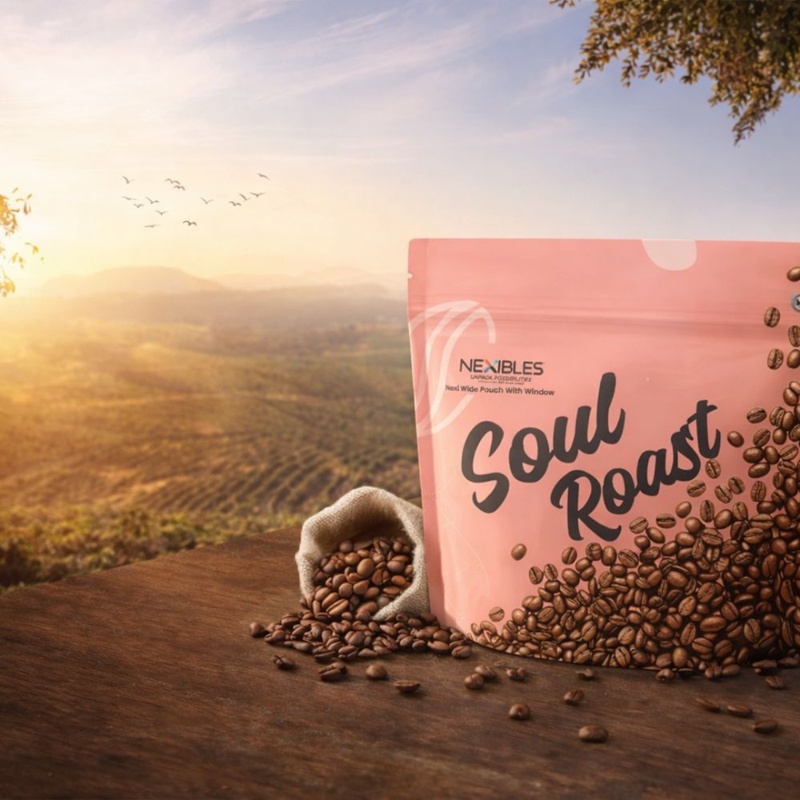
How Coffee Pouch Packaging Helps Preserve Coffee Freshness
The Real Reason Your Coffee Tastes Flat
A Bangalore café owner once told us something that stayed with us. She had sourced a beautiful washed Arabica from a small estate in Chikmagalur, roasted it carefully in-house, and packed it in a stock standup pouch she had been using for two years. Three weeks after the batch went out, a loyal customer came back and said the bag she bought tasted “a little flat.” Same roast. Same beans. Same roaster. Different outcome.
She was convinced the problem was her roasting. She adjusted profiles, changed rest times, tried different grind settings for the retail bags. Nothing worked. The complaints continued — not always, not for everyone, but often enough to worry her.
It took an honest conversation with a packaging supplier to discover the real culprit. It was never the roast. It was the pouch.
This is a story that is playing out in roasteries and cafés across India — from Koramangala to Colaba, from Defence Colony to RA Puram. And the tragedy of it is that the roasters carrying the blame are usually doing nothing wrong at all. The problem is structural. It is baked into the materials most stock pouches are made of, and it begins the moment you seal that bag.
“Coffee doesn’t just go stale from age. It goes stale from oxygen, moisture, and light — and if your pouch cannot block all three, your best before date is a fiction.”
The Science of Staling: What’s Happening to Your Coffee Right Now
Most people think coffee goes stale because it gets old. That’s only partly true. Coffee goes stale primarily because of four things happening simultaneously inside and outside your pouch, from the moment you seal it:
Oxidation — the silent flavour destroyer — the moment roasted coffee contacts oxygen, aromatic compounds behind brightness, sweetness, and complexity begin to break down. Lipids oxidise into compounds that taste rancid, flat, and bitter. Research confirms the ratio of unsaturated to saturated fatty acids drops after prolonged oxygen exposure — and those unsaturated fats carry the floral, fruity, and sweet notes that define a specialty roast. The compounds that make a light roast taste like jasmine and bergamot are the first things oxygen destroys.
Moisture absorption — the flavour dampener — Bangalore in June, Mumbai in July, Chennai in August: India’s humidity is brutal by global packaging standards. Roasted coffee is hygroscopic and absorbs moisture that dissolves and releases aromatic volatiles. Your coffee smells weaker, brews weaker, and tastes flatter. In a pouch with a weak moisture barrier — which describes most stock pouches — this can begin within days. The pouch is not keeping humidity out. It is simply slowing it down.
CO₂ degassing — the problem nobody talks about — freshly roasted beans release carbon dioxide for 24–72+ hours (and at a lower rate for days or weeks after). Sealed without a one-way valve, the pouch inflates — sometimes to the point of bursting in transit — and seals get stressed, letting oxygen exchange back in. If you roast and seal within 48 hours without a valve, you are almost certainly losing flavour.
Light degradation — invisible but real — UV and visible light accelerate oxidation and lipid degradation. A transparent pouch looks premium on the shelf, but a fully transparent, non-metallised pouch offers zero light protection. Every hour under retail lighting quietly ages your coffee faster than it should.
None of this is dramatic day to day — but at three or four weeks, the difference is unmistakable in the cup.
Coffee Pouch Barrier Science
What’s Actually Inside a Stock Pouch — and What It Cannot Do
Walk into any packaging supplier in Bangalore, Mumbai, or Delhi and ask for a stock coffee pouch, and you’ll typically get a structure built around BOPP (Biaxially Oriented Polypropylene) or PET (Polyethylene Terephthalate) as the primary film, with a polyethylene inner layer for heat sealing. These materials are functional and food-safe, and adequate for products less oxygen-sensitive than freshly roasted specialty coffee. But for a Yirgacheffe, a Coorg estate single-origin, or a carefully developed espresso blend, they simply aren’t enough.
OTR (Oxygen Transmission Rate) measures how much oxygen passes through a material per unit of time — for specialty coffee, you want this as close to zero as possible. Real-world OTR values for materials commonly used in India:
Basic BOPP / PET film (most stock pouches in India) — High OTR — Inadequate — oxygen enters freely over weeks
Metalized PET (MPET) (mid-grade pouches) — Moderate OTR — Acceptable for short shelf life, not ideal
BOPA / Nylon (Biaxially Oriented Polyamide) (premium transparent pouches / Nexi Clear) — Low OTR — Excellent barrier with superior flex-crack resistance
Aluminium Foil Laminate (premium metallic pouches / Nexi Metallic) — Near-zero OTR — Best-in-class — blocks oxygen, moisture, and light completely
The gap between basic BOPP and aluminium foil isn’t incremental — it’s the difference between coffee arriving fresh at week three, or tasting like a suggestion of what it once was. Aluminium foil has WVTR and OTR both effectively near-zero — the gold standard for maximum freshness protection. BOPA adds excellent oxygen barrier plus superior flex-crack resistance, holding barrier integrity even when squeezed, folded, or transported roughly — unlike thinner films that develop micro-pinholes under physical stress.
The Three Tiers of Coffee Pouch Barrier — Which One Are You Using?
01 — Basic: Stock Pouch (BOPP / PET) — Functional and cheap. Adequate for coffee consumed within 1–2 weeks. Fine for informal channels and local deliveries with very short shelf life. Not suitable for retail, gifting, or D2C where the bag may sit 3–6 weeks before opening. High OTR — short window.
02 — Mid-Grade: Metalized PET (MPET) — Better than plain BOPP. Some oxygen and light barrier. Works reasonably for 4–6 week shelf life. Metallized coating can be compromised by flex-cracking, creating microscopic pinholes. Still not right for a premium specialty roast. Moderate OTR — medium window.
03 — High Barrier: Aluminium Foil + BOPA (Nexi Wide) — The structure used in export-grade specialty packaging globally. Aluminium foil (metallic) = near-zero OTR and complete light block. BOPA (transparent) = high oxygen barrier with excellent flex resistance. Coffee stays at peak flavour longer — happier customers, fewer complaints, a brand known for freshness. Near-zero OTR — long window.
The Degassing Valve: The Most Overlooked Component in Indian Coffee Packaging
Walk through any good specialty coffee shop in Bangalore or Hyderabad and look closely at the bags on the shelf. Almost every imported specialty bag — Blue Bottle, Stumptown, Tim Wendelboe — has a small circular valve on the front. Most Indian-branded bags do not. This is a significant gap.
Freshly roasted coffee releases CO₂ for 24 to 72+ hours. Sealed in an airtight pouch with no valve, that gas has nowhere to go — the pouch inflates and seals get stressed. In humid Indian conditions this can happen very quickly, and a stressed seal lets oxygen back in.
A one-way degassing valve solves this elegantly: it opens only under positive internal pressure (CO₂ pushing out) and stays closed under negative or neutral pressure. CO₂ exits freely while oxygen is physically kept out, so beans degas while the barrier stays intact.
Yes, absolutely: if you seal beans within 24–72 hours of roasting — especially for D2C, quick-commerce, or café counters. A one-way valve is not an optional extra for fresh-roasted coffee. It is essential.
Optional but recommended: if beans rest 5–7 days before sealing — CO₂ has mostly dissipated, but a valve still protects seals in transit
Not required: if coffee is rested 10+ days in a controlled environment before packaging
Coffee pouch degassing valve
What to Look for When Choosing a Coffee Pouch — A Buying Checklist
The next time you are evaluating a coffee pouch — whether ordering for the first time or reconsidering your current supplier — here is what to ask and what to look for.
What the pouch must have
High-barrier material in the structure — ask specifically: is there aluminium foil or BOPA in this laminate? If the answer is “it is BOPP-based,” push back or look elsewhere for specialty-grade applications
A proper zipper closure — once a customer opens the bag, they need to reseal it. Without a zipper, remaining coffee is exposed to open air — a controllable source of staleness entirely in your packaging decision
Food-grade certification — confirm materials are certified for direct food contact. Non-negotiable for any retail or D2C product
A degassing valve option — if you sell freshly roasted beans, the valve is not optional. Ensure your supplier can provide it
What to test before a large order
Request a physical sample — squeeze the pouch: does it crinkle or hold its shape? A high-barrier structure feels substantially different from basic film. You will notice immediately
Seal your own beans in a sample, wait three weeks, open and smell immediately, then compare aroma to a same-day sealed bag. The difference in aroma tells you everything
Check the zipper under humidity — leave a sealed sample in a humid space (e.g. bathroom) for 48 hours, then inspect the seal. This simulates Indian transit and storage conditions
What most Indian roasters currently miss
Roast date visibility — if your pouch does not show the roast date prominently, specialty buyers — the highest-value segment — will not fully trust it. Roast date is the credibility signal. Print it
Batch and origin information — a pouch that says “Medium Roast” tells a specialty buyer nothing. Origin, altitude, process, and variety justify a premium price and build repeat purchase behaviour
Light blocking — fully transparent pouches under retail lighting accelerate degradation you cannot see. Consider whether full transparency is worth the shelf-life cost for your distribution model
nexibles
.