How Packaging Design Is Changing the Role of Corrugated Boxes in Modern E-Commerce
For years, corrugated boxes were mainly viewed as practical containers designed to move products safely from one location to another. Their strength, lightweight construction, and relatively low production cost made them a natural choice for shipping. However, the rapid growth of e-commerce has changed what businesses expect from packaging. A box now has to do more than protect an item during transportation; it can influence how a customer experiences a product from the moment the delivery arrives. The growing use of Custom Corrugated Boxes reflects this shift. Instead of relying only on standard sizes and plain surfaces, e-commerce businesses are exploring packaging designs that combine structural protection with visual appeal, efficient space utilization, and brand communication. This development is turning corrugated packaging from a simple shipping component into a more carefully designed part of the overall customer journey.
The E-Commerce Supply Chain Demands Smarter Packaging
Products sold online may pass through warehouses, sorting facilities, delivery vehicles, and multiple handling points before reaching the customer. During this process, packaging can experience pressure, vibration, stacking, and sudden movement. A box that looks suitable on a warehouse shelf may not necessarily perform well throughout this entire journey. Modern packaging design therefore considers how a corrugated box will behave across the complete distribution process. Designers can select suitable board strength, dimensions, internal structures, and protective inserts according to the product being shipped. This approach helps businesses avoid treating every product as if it requires the same packaging solution. At the same time, unnecessary packaging material can increase shipping volume and storage requirements. Designing a box around the actual dimensions of the product can create a more efficient balance between protection and material usage.
Design Is Becoming Part of the Unboxing Experience
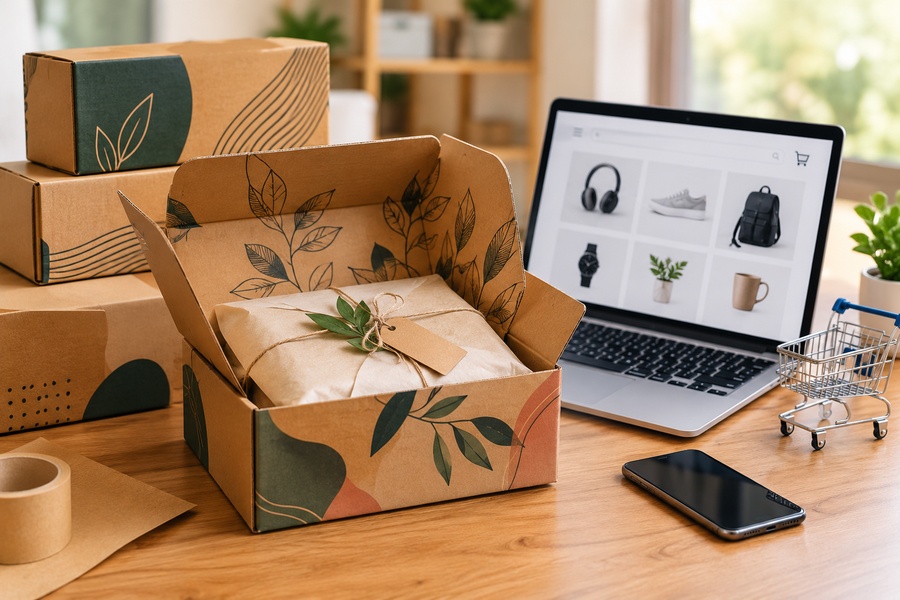
The delivery box is often the first physical interaction a customer has with an online brand. Unlike a traditional store environment, e-commerce businesses cannot rely on shelves, displays, or in-store presentation to create that first impression. Packaging can fill part of that gap. A thoughtfully designed corrugated box can introduce a brand through its shape, printing, opening mechanism, internal arrangement, or minimal visual details. Even relatively simple design elements can make the opening process feel more organized and intentional. This does not mean that every shipping box needs elaborate graphics or expensive finishing. Effective packaging design can also come from practical decisions, such as creating a clean opening experience, preventing excessive movement inside the box, or arranging the product and protective materials in a logical way.
Moving Beyond the Standard Box Shape
Traditional rectangular cartons remain useful, but modern packaging design is becoming more flexible. E-commerce brands are experimenting with dimensions and structural formats that are better suited to particular products. A box designed for clothing may require a different structure from one used for cosmetics, electronics, food products, or fragile items. Adjustable flaps, inserts, dividers, locking mechanisms, and product-specific compartments can all change how a corrugated package performs. This structural approach demonstrates why packaging design should begin with the product and distribution requirements rather than simply selecting a standard box and adapting the product to it.
Designing Corrugated Packaging for Material Efficiency
One of the major changes in e-commerce packaging is the growing attention toward material efficiency. Businesses are looking for ways to protect products without automatically increasing the amount of cardboard, fillers, or additional protective materials used in every shipment. Right-sizing is particularly relevant for online retailers. When a box is significantly larger than its contents, additional void-fill may be required, while unused space can also increase the overall shipping volume. A more appropriately sized corrugated package can help create a compact shipment while still providing sufficient protection around the product.
Corrugated Packaging and Sustainable E-Commerce
Sustainability has also become an important consideration in packaging development. Corrugated materials are widely used in shipping because their fiber-based construction can fit into recycling systems in many markets. However, sustainable packaging is not simply about choosing one material over another. The complete packaging design—including material quantity, box dimensions, durability, reuse potential, and transportation efficiency—can influence its environmental impact. For e-commerce businesses, a durable box can also reduce the possibility of product damage during delivery. Preventing damaged products can avoid additional packaging, replacement shipments, and unnecessary transportation. In this way, packaging performance and sustainability can sometimes work toward the same objective.
Printing Turns the Shipping Box Into a Communication Tool
Another important development is the use of the outer surface as a communication space. Corrugated boxes can carry logos, colors, product information, handling instructions, or simple visual elements that help establish brand recognition. For online businesses, this provides an opportunity to maintain a consistent identity beyond the website or mobile application. When a branded package arrives at a customer’s home, its appearance can connect the physical delivery with the digital shopping experience. However, effective packaging communication does not require covering every available surface with graphics. A clear visual hierarchy can often make important information easier to recognize while keeping the overall package clean and functional.
Packaging Design Can Influence Reverse Logistics
E-commerce packaging also needs to account for what happens after delivery. Customers may need to return, exchange, store, or transport products again. A box that is difficult to open or impossible to reseal may create unnecessary complications during the return process. Designers are therefore considering features such as easy-open strips, resealable closures, and structures that can withstand another handling cycle. These small structural changes can make corrugated packaging more useful beyond the initial delivery. This broader perspective changes the role of the shipping box. Instead of being designed only for the journey from warehouse to customer, packaging can be developed with several stages of the product lifecycle in mind.
Smart Design Can Improve the Shipping Process
As e-commerce continues to develop, packaging design is increasingly connected with operational efficiency. A well-designed corrugated box can be easier to store, stack, handle, and transport. These factors may appear small individually, but they become significant when a business ships hundreds or thousands of orders. Standardized dimensions can help warehouses organize inventory more efficiently, while structural consistency can simplify Custom Packaging Solutions processes. Some businesses are also exploring packaging designs that reduce the number of separate components needed to prepare an order. The objective is not simply to create a visually attractive box. Modern packaging design considers the complete journey of the product and looks for opportunities to improve performance at multiple stages.
Personalization Is Expanding the Role of Corrugated Boxes
Another emerging trend is greater personalization. Digital printing technologies and flexible manufacturing processes have made it easier for brands to create packaging with distinctive graphics without necessarily depending on extremely large production runs. This can be particularly useful for smaller e-commerce businesses, seasonal campaigns, product launches, subscription services, and limited-edition products. Personalization can also extend beyond graphics. Different box sizes, opening styles, inserts, and internal layouts can be selected according to specific products or fulfillment requirements.
Technology Will Continue to Influence Packaging Design
The future of e-commerce packaging is likely to involve a closer connection between physical packaging and digital technology. QR codes, digital product information, tracking features, and interactive brand experiences can turn an ordinary shipping box into another communication channel. At the same time, packaging development is becoming increasingly data-driven. Businesses can examine shipping damage, product returns, material consumption, package dimensions, and customer feedback to identify where packaging improvements are needed. This creates a continuous improvement cycle: packaging is designed, tested in real-world distribution, evaluated through performance data, and then refined.
The Future of Corrugated Packaging in E-Commerce
Corrugated boxes are still fundamentally responsible for protecting products during transportation, but their role in e-commerce has expanded considerably. Modern packaging design brings together product protection, material efficiency, sustainability, branding, customer experience, and logistics rather than treating these elements separately. The result is a more purposeful approach to corrugated packaging. Instead of viewing the box simply as something that surrounds a product, e-commerce businesses can treat it as an engineered part of the delivery system and an important physical touchpoint between a brand and its customer.
Frequently Asked Questions
1. Why are corrugated boxes important for e-commerce businesses?
Corrugated boxes provide a practical combination of strength, lightweight construction, and product protection. They help products withstand handling and transportation while providing businesses with flexible packaging options.
2. How is packaging design changing corrugated boxes?
Modern packaging design focuses on more than basic protection. Box dimensions, structural features, branding, sustainability, opening experience, and shipping efficiency are now considered during the design process.
3. What are custom corrugated boxes used for?
Custom corrugated boxes can be designed around specific products, allowing businesses to select suitable dimensions, board strength, internal protection, and printing according to their shipping requirements.
4. Can corrugated packaging improve the e-commerce customer experience?
Yes. Packaging is often the first physical interaction customers have with an online brand. A well-designed box can create a more organized opening experience while reinforcing the brand’s visual identity.
5. How does right-sized packaging help online retailers?
Right-sized packaging can reduce unnecessary empty space and the need for excessive void-fill. It can also make shipments more compact, which may improve storage and transportation efficiency.
6. Are corrugated boxes suitable for sustainable packaging?
Corrugated packaging can support sustainability goals because fiber-based packaging is widely used in recycling systems. However, sustainability also depends on factors such as material quantity, durability, package size, and transportation efficiency.
7. How can corrugated boxes protect products during shipping?
The layered structure of corrugated board provides strength and cushioning. Businesses can further improve protection by selecting appropriate board grades, dimensions, inserts, and internal supports for individual products.
8. Can corrugated boxes be used for product branding?
Yes. Corrugated boxes can incorporate logos, colors, graphics, product information, and other brand elements. This allows the shipping package to become part of the customer’s overall brand experience.
9. Why is box size important in e-commerce packaging?
Box size affects product protection, material consumption, storage, and transportation. A package that closely matches the product’s requirements can reduce unnecessary space while maintaining adequate protection.
10. How can packaging design support product returns?
Packaging can be designed with resealable closures, easy-opening features, and durable structures that make the box easier to handle during a return or exchange.
11. What role does digital printing play in corrugated packaging?
Digital printing allows businesses to produce customized graphics and packaging designs with greater flexibility. It can be useful for seasonal campaigns, product launches, limited editions, and smaller production runs.
12. Can corrugated packaging be personalized for different products?
Yes. Businesses can customize dimensions, printing, internal layouts, inserts, and opening mechanisms according to different products and fulfillment requirements.
13. How does packaging affect shipping efficiency?
Packaging dimensions and weight influence how products are stored, handled, and transported. Efficiently designed boxes can help businesses make better use of warehouse and shipping space.
14. What is smart packaging in e-commerce?
Smart packaging can combine physical packaging with technologies such as QR codes, digital product information, tracking features, or interactive content to provide additional information and customer engagement.
15. Why should packaging be designed around the product?
Different products have different weights, shapes, fragility levels, and transportation requirements. Designing the package around these characteristics can provide more appropriate protection and avoid unnecessary material use.
sophia