Explosion Proof ATEX PTZ Camera With IR and DSEAR Compliance: A UK Buyer’s Guide
Most equipment failures in hazardous areas trace back not to a faulty product, but to a mismatched one — a camera installed in a zone it was never certified for. DSEAR doesn’t care how good your supplier’s brochure looks. It requires you, as the employer, to have assessed the risk and matched your equipment to it, with documentation to prove the decision was sound. For procurement teams buying surveillance equipment for classified sites, that’s where most avoidable compliance gaps actually begin — not in the hardware, but in the paperwork behind it.
What DSEAR Actually Requires From Your Team
The Dangerous Substances and Explosive Atmospheres Regulations place a direct duty on you to assess where dangerous substances could create an explosive atmosphere, then control the risk accordingly. This isn’t a one-off checkbox. It means identifying every area where flammable gas, vapour, mist or combustible dust could accumulate, classifying those areas formally, and ensuring anything installed within them — including cameras — is certified for that specific classification.
Your explosion protection documentation, often shortened to the EPD, is the record that ties all of this together. It’s the document an HSE inspector will ask for, and it’s where every piece of electrical equipment in a classified zone needs to be logged against its certification. A camera bought without this trail in mind creates a gap in that record from day one.
How Hazardous-Area Classification Drives Camera Selection
Zone classification isn’t a formality — it’s the single factor that determines which cameras you’re legally permitted to install. Get the zone wrong on your risk assessment, or buy equipment rated for a lower zone than your site actually has, and you’ve created a compliance failure that sits quietly until an incident or an inspection exposes it.
This is why an Explosion Proof ATEX PTZ Camera With IR needs to be selected against your site’s documented zone classification, not a generic assumption about what “explosion proof” covers. Two sites with superficially similar layouts can carry entirely different zone ratings depending on ventilation, substance volatility and release frequency — which means the same camera model might be perfectly compliant on one site and completely wrong for another.
Gas Zones 0, 1, 2 and Dust Zones 20, 21, 22
Gas and dust hazards are classified on separate scales, and mixing them up is a common procurement error. For gas and vapour atmospheres, Zone 0 covers areas where an explosive atmosphere is present continuously or for long periods, Zone 1 covers likely occurrence during normal operation, and Zone 2 covers atmospheres that are only expected occasionally and briefly.
Dust hazards use a parallel but distinct system: Zone 20, 21 and 22 follow the same logic — continuous, likely, and occasional presence — but apply to combustible dust clouds rather than gas or vapour. A hazardous area ex-proof PTZ IR camera rated for gas Zone 1 is not automatically suitable for a dust Zone 21 area; the certification, testing standards and marking are different, and your supplier should be able to confirm both explicitly rather than treating them as interchangeable.
Why ATEX Certification Alone Isn’t Enough
A certified product is the starting point, not the finish line. ATEX certification tells you the equipment has been tested and is suitable for certain zone, gas group and temperature class combinations — it does not tell you it’s suitable for your site. That judgement call sits with you, and it needs to be documented as a site-specific equipment assessment, not assumed from a datasheet.
This matters particularly for facilities across the UK’s industrial manufacturing, warehousing and automotive sectors moving into hazardous-area monitoring for the first time, often without in-house DSEAR expertise. Treating ATEX marking as a substitute for that assessment is one of the most common — and most easily corrected — gaps HSE inspectors flag during site visits.
Documents Your Procurement Team Should Request
Before any camera reaches site, your procurement process should demand a defined document set from your ex proof PTZ IR camera supplier UK — not just a product code and a delivery date. At minimum, request:
The full ATEX or IECEx certificate, showing zone, gas group and temperature class
The EU Declaration of Conformity or UKCA equivalent
Full equipment marking details, matched against the certificate
Installation instructions specific to hazardous-area mounting and cable entry
An explosion proof ir ptz camera for Hazardous Areas without this full document set shouldn’t leave the shortlist, regardless of price or lead time.
Recording the Camera in Your Explosion Protection Documentation
Once installed, the camera needs a formal entry in your site’s explosion protection documentation — not a filing-cabinet afterthought. Record its certificate reference, zone rating, installation date and maintenance schedule alongside every other piece of ATEX-rated equipment on site. This is what turns a compliant purchase into a compliant, auditable installation, and it’s exactly what an HSE inspector will expect to see referenced during any DSEAR review.
SharpEagle ATEX certified Explosion Proof ATEX PTZ Camera With IR UK
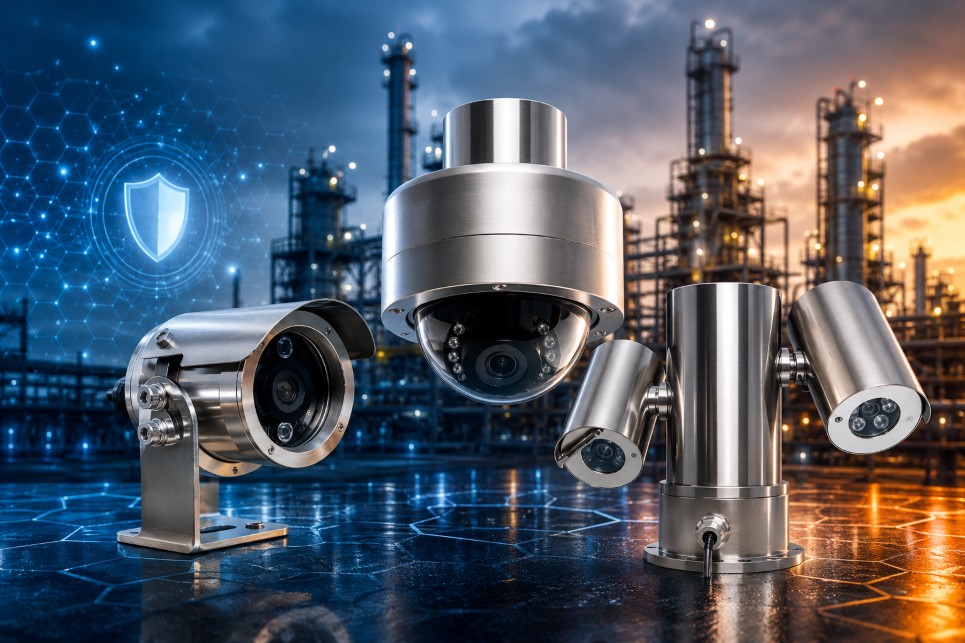
SharpEagle Technology’s ATEX certified Explosion Proof ATEX PTZ Camera With IR UK is supplied with the full certification package your procurement and compliance teams actually need — ATEX and IECEx certificates, Declaration of Conformity, complete equipment marking and installation documentation ready for your explosion protection file. Built with a corrosion-resistant stainless steel housing and long-range infrared illumination, it’s rated across Zone 1 and Zone 2 gas environments, giving oil and gas, maritime and industrial manufacturing sites a genuine IR PTZ camera hazardous area oil and gas operators can specify with confidence rather than guesswork.
Looking Ahead
As HSE scrutiny of hazardous-area documentation continues to sharpen, sites that treat certification paperwork as seriously as the hardware itself will be the ones that pass inspection without incident. A well-documented explosion proof PTZ camera oil and gas UK installation protects both your workforce and your compliance record. If your site needs a supplier of hazardous area PTZ cameras UK teams can trust for both product and paperwork, contact SharpEagle Technology today.
SharpEagle Technology
.