Explosion Proof PTZ Dome Camera Guide: UK Oil & Gas
A single spark in the wrong atmosphere can shut down a plant for months. HSE figures consistently show that process safety incidents at UK hazardous sites carry costs running into millions once you factor in downtime, investigation and reputational damage. Yet many facilities still rely on standard CCTV pushed into a “hazardous-ish” corner, hoping it holds up. If your site handles flammable gases, vapours or dust, your surveillance equipment isn’t a convenience item. It’s part of your safety case. This guide walks through what you actually need to know before you sign a purchase order.
Why Hazardous Area Surveillance Can’t Be an Afterthought
Refineries, tank farms and offshore platforms operate in zones where a non-rated camera housing could itself become an ignition source. Under DSEAR, your facility is legally required to assess explosive atmospheres and select equipment rated for the specific zone. A camera isn’t exempt just because it’s “only monitoring.”
For your team, that means:
Confirming the zone classification (0, 1, 2 for gas; 20, 21, 22 for dust) before specifying any camera
Checking that housings, cabling and connectors all carry matching protection ratings — not just the camera body
Documenting equipment selection as part of your DSEAR risk assessment, not as a bolt-on afterthought
Sites across the North Sea, Teesside, Grangemouth and the Humber refining cluster have all tightened camera specifications in recent years as insurers and auditors scrutinise process safety documentation more closely.
ATEX and IECEx Considerations You Shouldn’t Skip
An explosion proof ptz type dome camera needs certification that matches your actual operating environment, not just a sticker that looks reassuring on a spec sheet. Under the ATEX Directive, equipment used in explosive atmospheres must carry the correct Ex marking, gas group, temperature class and Equipment Protection Level for your zone. IECEx certification matters too if your operations span international sites, since it’s recognised more broadly outside the EU/UK framework.
Before approving any supplier, ask for:
The full ATEX certificate, not a marketing summary
Confirmation of temperature class suitability for your process gases
Evidence of third-party testing, not self-certification alone
An ATEX certified ptz type dome camera UK buyers can defend during an HSE inspection is one with paperwork that traces cleanly back to a notified body.
PTZ vs Fixed: Choosing the Right Explosion Proof Dome Camera
This is where most procurement teams get stuck. A fixed camera gives you a locked field of view — reliable, simple, and often cheaper to certify and maintain. An Explosion proof ptz dome camera gives you pan-tilt-zoom coverage that can follow activity, zoom into a suspect valve, or sweep a wide tank farm from a single mounting point.
Neither is universally “better.” Use fixed units where you need constant, unbroken coverage of a specific asset — a loading arm, a control room door, a flare stack base. Reach for PTZ where the area is large, the risk shifts location, or operators need to actively investigate an alarm in real time. Many facilities run both in combination: fixed cameras for perimeter and choke points, an explosion proof fixed type dome camera on critical static assets, and PTZ units covering larger process areas where flexibility earns its keep.
Procurement Checklist for Hazardous Area Cameras
Before you commit budget, work through this list with your safety and engineering teams together — procurement decisions made in isolation from EHS almost always cost more to fix later:
Zone classification confirmed and documented
Ex certification matched to gas group and temperature class
IP rating adequate for offshore or wash-down environments
Cabling and glands rated to the same standard as the housing
Integration compatibility with your existing VMS
Supplier able to provide UK-based technical support and spares
A hazardous area ptz dome camera UK teams can install without special dispensation from the local authority having jurisdiction will save weeks of delay compared with equipment requiring bespoke approval.
Maintenance Planning and Where PTZ Earns Its ROI
Ex-rated equipment demands scheduled inspection under DSEAR and PUWER — you can’t simply install and forget. Build in periodic visual checks of glands and seals, functional testing of pan-tilt mechanisms, and lens cleaning cycles that account for offshore salt exposure or onshore dust loading.
Where PTZ genuinely pays for itself is coverage density. One well-placed unit covering a wide tank farm or jetty can replace three or four fixed cameras, cutting both capital cost and the number of Ex-rated penetrations through your process area. For maritime terminals and offshore platforms where every cable run adds cost and risk, that reduction in hardware footprint is often the deciding factor.
SharpEagle Technology’s ATEX Certified Explosion Proof PTZ Dome Camera
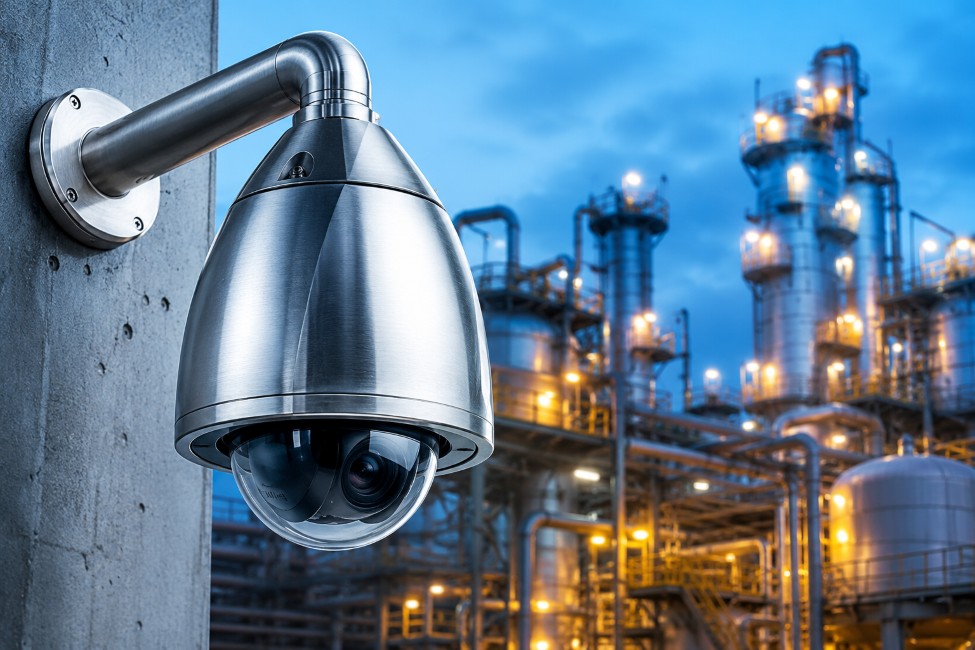
For teams ready to specify, SharpEagle Technology’s ATEX certified explosion proof PTZ dome camera is built specifically for UK hazardous-zone deployment. Full details sit on the SharpEagle Technology product page.
Key features include full 360° continuous pan rotation, high-optical-zoom lenses for long-range identification across tank farms and jetties, stainless steel or aluminium alloy Ex-rated enclosures, and integrated heating elements for reliable performance through UK winters and offshore conditions.
Benefits for hazardous-zone operators: fewer cameras needed per site thanks to wide-area PTZ coverage, reduced installation complexity versus multiple fixed units, and documentation packages that slot straight into your DSEAR and ATEX compliance files.
Unique selling points worth noting: an ATEX certified fixed ptz type dome camera UK engineering teams can pair alongside SharpEagle’s fixed range for mixed-coverage sites, responsive UK technical support, and certification traceable to recognised notified bodies — critical when an auditor asks for evidence, not assurances. This positions SharpEagle as a genuine atex ptz camera for oil and gas UK specification, rather than a repurposed general-industry unit.
Conclusion
Hazardous area surveillance is only going to face tighter scrutiny as insurers and regulators push for stronger process safety evidence across UK oil, gas, chemical and maritime sites. Getting your camera specification right now — matched certification, sensible PTZ-and-fixed combinations, and a realistic maintenance plan — saves you from costly retrofits later. Speak to SharpEagle Technology’s engineering team to specify the right explosion proof dome camera for your facility.
SharpEagle Technology
.