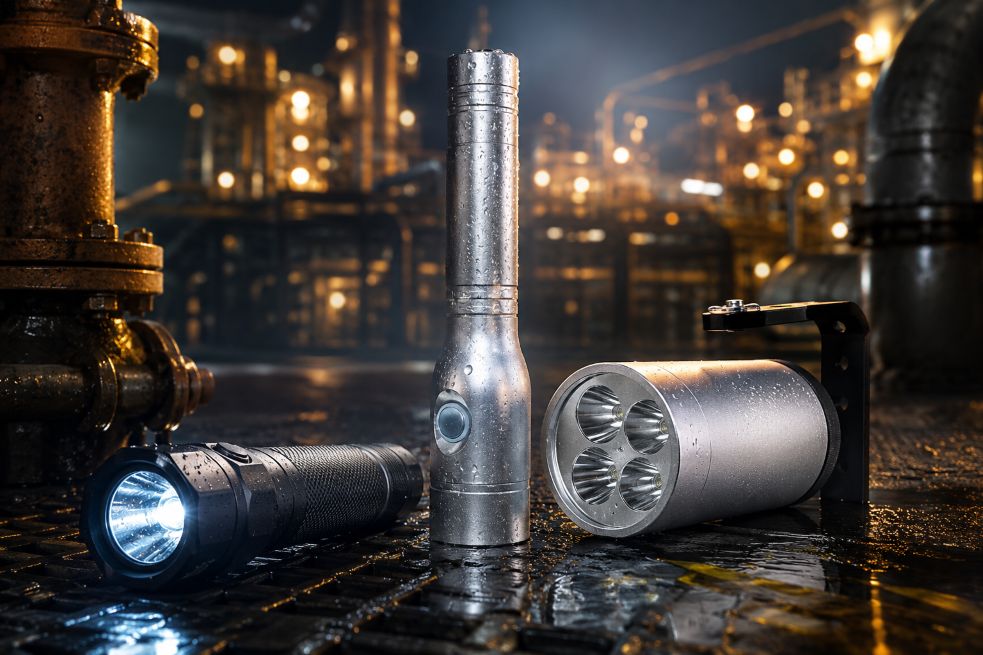
Explosion Proof Flashlight UK vs Standard Torch Cost
Explosion Proof Flashlight UK vs Standard Torch: The Real Cost of Non-Certified Lighting
A £15 torch from a high street hardware shop and a certified hazardous-area light can look almost identical on a shelf. On a process site, that resemblance is where the trouble starts. HSE incident data consistently shows that ignition sources on hazardous sites are rarely the equipment operators expect — they’re the everyday items nobody flagged as a risk. A cracked torch casing, a corroded battery contact, a switch that arcs on contact: none of these announce themselves before something goes wrong. For safety officers across UK oil, gas, manufacturing and maritime sites, the question isn’t whether certified lighting costs more upfront. It’s what non-certified lighting actually costs when you add up everything it puts at risk.
Consumer Torches vs Certified Hazardous-Area Equipment
The gap between a standard torch and a certified unit isn’t cosmetic. Consumer torches are engineered for cost and convenience: thin plastic housings, exposed switch contacts, and battery compartments that were never assessed against explosive atmosphere risk. Certified hazardous-area equipment, by contrast, is tested and marked against specific gas groups, temperature classes and zone ratings, with every component — from the lens seal to the battery terminal — assessed for its potential to become an ignition source.
Put simply, a standard torch tells you nothing about what happens when it’s dropped, cracked, or run down inside a Zone 1 area. A certified unit comes with documented evidence that it won’t.
How Ordinary Faults Become Ignition Sources
It rarely takes catastrophic failure to create risk. Everyday wear is usually enough:
Heat build-up in a poorly ventilated plastic casing can exceed the auto-ignition temperature of certain hydrocarbon vapours during extended use
Internal sparking at low-quality switch contacts, especially once corrosion or moisture ingress sets in
Damaged batteries, particularly cheap alkaline cells that swell, leak or short internally after impact
Cracked housings, which expose internal electronics to gas or vapour ingress that the unit was never designed to resist
None of these faults look dramatic in isolation. Combined with a Zone 1 or Zone 2 atmosphere, any one of them is sufficient.
Direct and Indirect Costs of Getting It Wrong
The financial exposure from non-certified lighting rarely shows up as a single line item, which is exactly why it gets underestimated. Direct costs include equipment replacement, incident investigation, and potential enforcement action. Indirect costs run deeper: unplanned shutdowns while an area is made safe, lost production during downtime, increased insurance premiums following a reportable incident, and the reputational cost of a site becoming known for compliance gaps.
Under DSEAR, employers carry a legal duty to eliminate or control ignition risk in classified areas. A HSE investigation following an incident will ask, directly, whether the equipment in use was suitable for the zone. “We didn’t realise” is not a defence that holds up.
The Role of DSEAR Assessments in Identifying Hazardous Zones
A thorough DSEAR assessment does more than tick a compliance box — it tells you precisely which zones exist across your facility and what equipment specification each one demands. Many sites across industrial regions like Teesside, Grangemouth and the Humber estuary run assessments that are technically compliant but out of date, missing new plant, modified processes, or areas where classification has shifted since the last review.
Your lighting procurement should follow directly from that assessment, not run in parallel to it. If your DSEAR documentation identifies a Zone 1 area, every torch entering that space needs a certificate that says it belongs there.
Total Cost of Ownership: The Numbers Finance Teams Actually Care About
Comparing purchase price alone flatters non-certified lighting and misleads the buyer. A proper total cost of ownership comparison includes:
Purchase price — certified units cost more initially, typically two to four times a basic consumer torch
Battery replacement frequency — cheap cells degrade faster and need replacing more often across a working fleet
Service life — a robust, IP-rated explosion proof LED flashlight UK teams maintain properly can outlast three or four disposable torches
Maintenance and recertification — factored into most certified units’ design, rather than an unplanned cost
Incident and downtime exposure — the largest and least predictable cost, and the one most likely to be omitted from a simple price comparison
SharpEagle ATEX Certified Explosion Proof Flashlight UK
SharpEagle Technology’s Explosion proof Handheld LED Torch UK range was built around exactly this total cost of ownership logic. Every unit carries full ATEX Zone 0/1/2 certification, an IP68-rated aluminium housing built to survive years of site use, and battery performance engineered for genuine full-shift reliability rather than best-case marketing figures.
As one of the UK’s recognised explosion proof flashlight suppliers, SharpEagle supplies complete documentation packs for DSEAR files, and pricing structured to make the business case straightforward for procurement and finance teams alike. Review the full specification on the SharpEagle Explosion Proof Flashlight product page. https://www.sharpeagle.uk/product/explosion-proof-flashlight
Making the Business Case to Finance
When you take this comparison to finance, frame it in numbers they already track: cost per unit over its working life, downtime hours avoided, and insurance or enforcement exposure reduced. An ATEX certified Explosion proof flashlight UK teams rely on isn’t a discretionary safety spend — it’s a measurable reduction in operational risk with a calculable payback period.
The sites that get this right treat lighting procurement as part of their DSEAR strategy, not a stationery-cupboard decision. Get in touch with SharpEagle Technology to build a lighting programme your finance team and your HSE lead can both stand behind.
SharpEagle Technology
.