How to Choose the Right Equipment for Efficient Production?
# Bottle Filling Machine: How to Select Suitable Equipment to Boost Your Production Efficiency
Bottle filling is a common step in food, beverage, cosmetic, pharmaceutical and chemical manufacturing. Many factories receive more orders and need higher output these days. Factories need reliable machines to fill different liquids into bottles. The filling volume must stay consistent and accurate. The machine should run steadily and cut material waste as much as possible.
A bottle filling machine automatically fills a fixed volume of liquid into bottles. Manufacturers can choose different machine structures and models based on product type, bottle style and production output.
When you pick a filling machine, do not only compare filling speed. You also need to check liquid viscosity, filling accuracy, bottle compatibility, cleaning requirements and whether you plan to expand production later.
This article explains how bottle filling machines work, common machine types and their suitable products, use cases across different industries, and key points you need to check before purchasing.
## 1. What Is a Bottle Filling Machine?
A bottle filling machine is industrial packaging equipment. It has semi-automatic and fully automatic versions. Its function is to fill a set amount of liquid into bottles.
Factories that produce drinks, cooking oil, sauces, skincare products, household cleaning liquids and industrial fluids widely use this equipment.
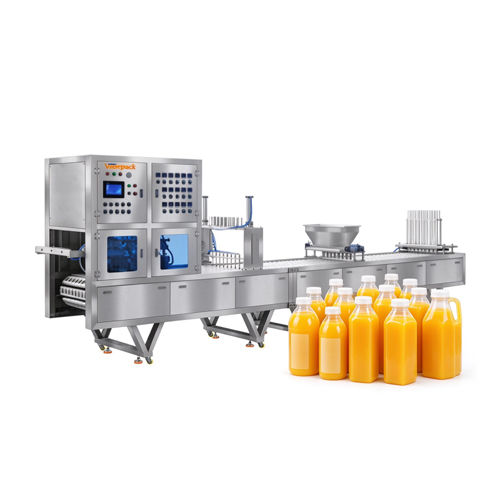
A complete fully automatic bottle filling production line usually includes these parts:
– Bottle feeding and conveyor system
– Bottle positioning unit
– Liquid storage tank / material supply system
– Filling pumps and filling nozzles
– Anti-drip structure
– Capping machine
– Labeling machine
– Finished product collection table
You can buy and run a filling machine alone. You can also connect it with other machines to build a complete filling and packaging line.
## 2. Working Process of an Automatic Bottle Filling Machine
Machines from different suppliers have different appearances and parts. But most automatic filling machines follow similar steps:
1. **Bottle Feeding**
Empty bottles move along the conveyor to the filling station. If you need continuous high-speed feeding, you can add an automatic bottle unscrambler to arrange empty bottles.
2. **Bottle Positioning**
Sensors or mechanical positioning units detect incoming bottles and stop each bottle right under the filling nozzle.
3. **Liquid Filling**
The filling unit adds liquid to the bottle according to the set weight or volume. You select the filling method based on how thick the liquid is, how fast it flows and the filling volume per bottle.
4. **Anti-drip Control**
Filling nozzles with anti-drip design reduce liquid residue on bottle openings and avoid material loss during production.
5. **Capping**
After filling, bottles move to the capping station. The machine places caps on bottles and tightens them to match cap specifications.
6. **Labeling and Collection**
Capped bottles go through the labeling machine to get labels, then move to the finished product collection area.
All steps run automatically. This reduces manual work and keeps filling results the same for every bottle.
## 3. Common Types of Bottle Filling Machines
Liquids have different thickness and flow features, so you need matching filling technology.
### Piston Bottle Filling Machine
It uses a piston and cylinder set to measure and discharge liquid.
It works well for medium-viscosity and thick materials, such as:
Shampoo, body lotion, face cream, thick sauces, liquid detergent, cream cosmetics.
The piston controls how much material comes out in each cycle. Piston filling is a good option if your product is thick.
### Gear Pump Bottle Filling Machine
Rotating gears move and measure liquid.
Common products for this machine: cooking oil, shampoo, liquid hand soap, lubricants, skincare oil and other pumpable liquids.
Gear pumps deliver liquid stably. You can adjust machine settings to match your output demand.
### Peristaltic Pump Filling Machine
Rollers squeeze a flexible tube to move liquid. The liquid only touches the inner tube wall and specified contact parts.
It fits for some pharmaceutical liquids, laboratory reagents and special-formula skincare products.
### Gravity Filling Machine & Flowmeter Filling Machine
Gravity filling machines rely on liquid’s own weight for filling. They only work for low-viscosity free-flowing liquids.
Flowmeter filling machines use sensors to count liquid volume passing through the pipe for metering. It is suitable when you need precise volume control.
Your final choice depends on product property, bottle size and filling accuracy requirement.
## 4. Industry Applications of Bottle Filling Machines
Filling machines serve many manufacturing sectors. Each industry has different requirements for products, machine material and hygiene standards.
### Food & Beverage Industry
Used for filling: drinking water, fruit juice, dairy drinks, cooking oil, vinegar, sauces, liquid condiments.
For food factories, focus on hygienic machine design, safe material for product contact parts, easy cleaning and compliance with food workshop rules.
### Cosmetic & Personal Care Industry
Used for filling: shampoo, conditioner, body lotion, facial cleanser, liquid hand soap, skincare oil, cosmetic toner.
These products vary a lot in viscosity and formula. Your filling machine should prevent dripping and splashing and reduce material waste.
### Pharmaceutical Industry
Mainly for liquid medicine and oral solutions.
Most pharmaceutical projects have strict rules for filling environment, cleaning validation, material standard and industry compliance.
### Chemical & Industrial Product Industry
Suitable products: disinfectant, liquid detergent, lubricant, industrial cleaning agent, automotive fluids.
Key selection points: whether machine material resists chemical corrosion, compatibility with your liquid and safety configurations.
## 5. Key Points to Check When You Choose a Bottle Filling Machine
Before selecting equipment, you need to clarify your production requirements.
1. **Your Product Feature**
First check the status of your liquid.
Is it thin like water, oily, easy to foam, thick cream, or mixed with small solid particles?
Different liquids need different pumps and filling structures. A machine for thin water-like liquid will not work well for thick cream or particle-containing products.
When you talk with suppliers about machine configuration, provide product samples or full product parameters.
2. **Bottle Size and Shape**
Bottle specifications directly decide machine configuration.
You need to confirm: filling volume per bottle, bottle height and diameter, neck size, bottle material and bottle shape.
If you run multiple bottle types on one line, choose machines with adjustable conveyors and simple changeover. This cuts downtime when you switch products.
3. **Filling Accuracy**
Consistent filling volume helps you control product quality, raw material cost and meet packaging regulations.
Actual filling error is affected by filling type, product feature, machine setup, production environment and regular maintenance.
Before you place an order, ask suppliers about the error range under your real production conditions. It is best to test the machine with your own liquid and bottles.
4. **Production Speed**
Machine output must match your factory’s production plan.
Small workshops can choose compact automatic filling machines. Large factories can select multi-head filling machines linked with capping and labeling machines.
When you evaluate capacity, check the real output of the whole line, not only the theoretical speed marked on the datasheet.
5. **Cleaning and Maintenance**
Food, cosmetic and chemical products have different cleaning requirements.
Choose machines where product contact parts can be removed easily. It should be simple to clean and switch between different products.
6. **Future Production Plan**
Think about whether you will increase output, add new products or change bottle sizes later.
Pick machines with adjustable functions and upgrade space. This avoids replacing the whole machine when you expand production later.
## 6. Automatic Bottle Filling Line: More Than Filling Alone
If you need high output, a connected full filling line works better than separate single machines.
A standard automatic filling and packaging line includes:
Automatic bottle unscrambler, conveyor system, liquid filling machine, capping machine, labeling machine, date coding machine, finished product collection table.
The full setup is customized based on your product, bottle type, target output and workshop layout.
All machines run in sync. It is also easier for factories to manage equipment and arrange production schedules.
## 7. Why Custom Filling Solutions Are Worth Considering
No single filling machine fits all products and production environments.
Filling drinking water into plastic bottles is very different from filling thick lotion into special-shaped bottles.
Custom adjustments usually include:
Different filling pump systems, adjustable filling nozzles, more filling heads, customized conveyor size, liquid storage tank, connection with capping and labeling machines, special contact materials and dedicated cleaning plans.
Work with an experienced packaging machinery manufacturer. They can build equipment to match your real production needs.
Prepare these documents before purchase: liquid information, filling volume, bottle dimensions, target output and available space in your workshop.
## 8. Conclusion
Buying the right bottle filling machine helps factories improve packaging efficiency, keep stable filling quality and support business growth.
Suitable equipment is determined by liquid viscosity, bottle specification, filling volume, production capacity and cleaning requirements.
If you check all the points above, you can find a filling solution matching your products and long-term production plan.
No matter your factory makes food and beverage, skincare goods, cleaning liquid or industrial fluids, a well-configured bottle filling system can support your packaging production stably.
Andy
.