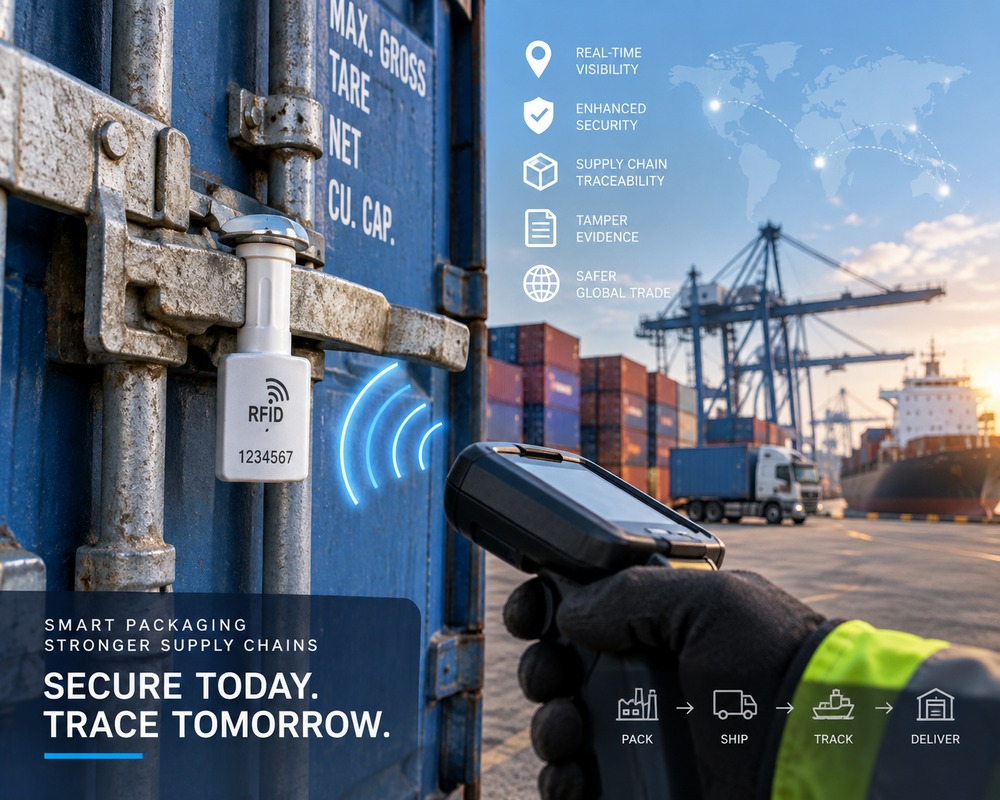
How RFID Security Seals Are Adding Traceability to Export Packaging
# How RFID Security Seals Are Adding Traceability to Export Packaging
Export packaging has traditionally focused on protecting goods from physical damage, moisture, contamination and handling risks. But as international supply chains become more connected, packaging is increasingly expected to do more than protect a product.
It is also becoming part of the information flow.
For export shipments, a container may pass through factories, warehouses, inland transport hubs, ports and distribution centres before reaching its destination. At each stage, businesses need to know what was shipped, whether the shipment remained intact and whether the physical shipment matches the information recorded in their systems.
This is where RFID-enabled security seals can add another layer of traceability to export packaging.
## From physical protection to digital identification
A conventional container seal provides a simple but important function: it helps indicate whether a container has been opened or tampered with after sealing.
However, a conventional seal generally requires someone to visually inspect the seal number and condition.
RFID introduces an electronic identification layer.
An RFID-enabled security seal can carry a unique electronic identity that can be captured using an RFID reader. Instead of relying entirely on manual inspection and recording, the seal can become part of a digital shipment record.
This distinction is important because traceability is not only about knowing where a shipment is. It is also about connecting the physical shipment with reliable identification data.
## Why this matters for export packaging
Export packaging often involves multiple handover points. A container can move from a manufacturing facility to a warehouse, from a warehouse to a transport operator, and eventually to a port.
Every handover creates an opportunity for information to become disconnected from the physical shipment.
A serialized RFID security seal can help create a stronger connection between the container and its digital record.
For example, when a container is sealed, its seal identity can be associated with information such as the container number, shipment reference, date and time of sealing, destination and other operational data.
When the container reaches a designated checkpoint, the RFID identity can be captured and compared with the expected record.
This creates a more structured way to verify that the physical shipment corresponds with the digital shipment information.
## RFID does not replace packaging security
It is important to distinguish identification from physical security.
RFID by itself does not make packaging tamper-proof. The physical construction of the seal remains important because the seal needs to provide visible or detectable evidence of unauthorized access.
This is why RFID security seals combine two concepts:
**Physical security + electronic identification**
The physical seal provides tamper evidence, while the RFID component provides an electronically readable identity.
For high-security freight containers, mechanical seal requirements are also addressed by standards such as ISO 17712:2013, which establishes procedures for the classification and acceptance of mechanical freight container seals.
The exact seal specification should therefore be selected according to the shipment, container, regulatory requirements and security process rather than simply choosing an RFID-enabled product because it contains RFID technology.
## Where RFID seals can fit into the packaging workflow
The technology can be useful at several points in an export packaging workflow.
### 1. Packing and sealing
Once the goods are packed and the container is ready for dispatch, the seal identity can be recorded against the shipment information.
### 2. Handover verification
At a warehouse, logistics facility or other controlled checkpoint, the seal can be scanned and compared with the expected shipment record.
### 3. Port and gate operations
RFID can reduce dependence on manually reading and entering seal numbers where suitable RFID infrastructure is available.
### 4. Receiving inspection
At destination, the seal identity and physical condition can be checked as part of the receiving process.
The objective is not necessarily to scan the seal at every point. Instead, RFID can be used at strategically selected checkpoints where automated identification adds value.
## The role of serialization
Serialization is one of the most important parts of an RFID-enabled packaging security system.
A unique identifier allows the physical seal to be associated with a specific shipment or container record.
This approach is consistent with the broader direction of supply-chain traceability, where identification standards and data capture technologies connect physical objects with information systems. GS1, for example, describes EPC/RFID as a means of connecting identifiers with visibility and traceability applications across supply chains.
For packaging and logistics teams, the practical lesson is simple: an RFID seal is most useful when its identity is connected to a defined business process.
A scan without a corresponding record does not create much operational value.
## Choosing the right level of technology
Not every shipment requires the same level of monitoring.
For some applications, a conventional high-security bolt seal may provide sufficient tamper evidence.
For shipments where automated identification and traceability are important, an RFID security seal may provide additional value.
For high-value or sensitive cargo that requires continuous location visibility, technologies such as GNSS or GPS-enabled electronic locks can provide another layer of monitoring.
These technologies should therefore be viewed as different levels within a broader cargo-security strategy rather than as interchangeable products.
## What packaging teams should evaluate
Before introducing RFID security seals into an export packaging workflow, companies should consider:
* The type and value of cargo
* Container and closure requirements
* Required level of tamper evidence
* RFID reading infrastructure
* Serialization requirements
* Integration with existing shipment records
* Checkpoints where scanning will actually take place
* Environmental and operating conditions
* Applicable standards and regulatory requirements
* Procedures for recording and investigating exceptions
The technology should fit the process rather than the other way around.
## The next step for smart export packaging
Packaging is gradually becoming more connected to the wider supply chain.
QR codes, RFID, NFC, sensors and other identification technologies are already expanding the role of packaging beyond physical protection. RFID-enabled security seals represent one practical application for export containers because they connect a physical security device with digital identification.
For exporters and logistics teams, the larger opportunity is not simply replacing a conventional seal with an RFID version. It is creating a reliable chain of information that connects sealing, handling, transportation and receiving.
When physical packaging and digital traceability work together, the container becomes more than a box carrying goods.
It becomes a traceable part of the supply chain.
Kanishka Sharma
.