How to Specify a Flexible Packaging Laminate: What Each Layer Actually Does
How to Specify a Flexible Packaging Laminate: What Each Layer Actually Does
A flexible packaging structure is not one material. It is several materials bonded together, and each one is there to do a specific job. When a pack fails, or costs more than it should, the cause is usually that one layer was asked to do something it was never chosen for.
This guide explains what the layers do, how to read a structure code, and what to test before you commit to a print run.
Why flexible packaging is built in layers
No single plastic film does everything well.
Polyester is strong and takes print beautifully, but it does not seal. Polyethylene seals at low temperature and survives handling, but it is soft and a poor oxygen barrier. Aluminium foil blocks almost everything, but it cannot be sealed to itself.
So converters combine them. The art of specification is deciding which properties matter most for your product, and which layers can deliver them at the lowest total cost.
The four jobs a laminate has to do
Every flexible structure is solving four problems at once:
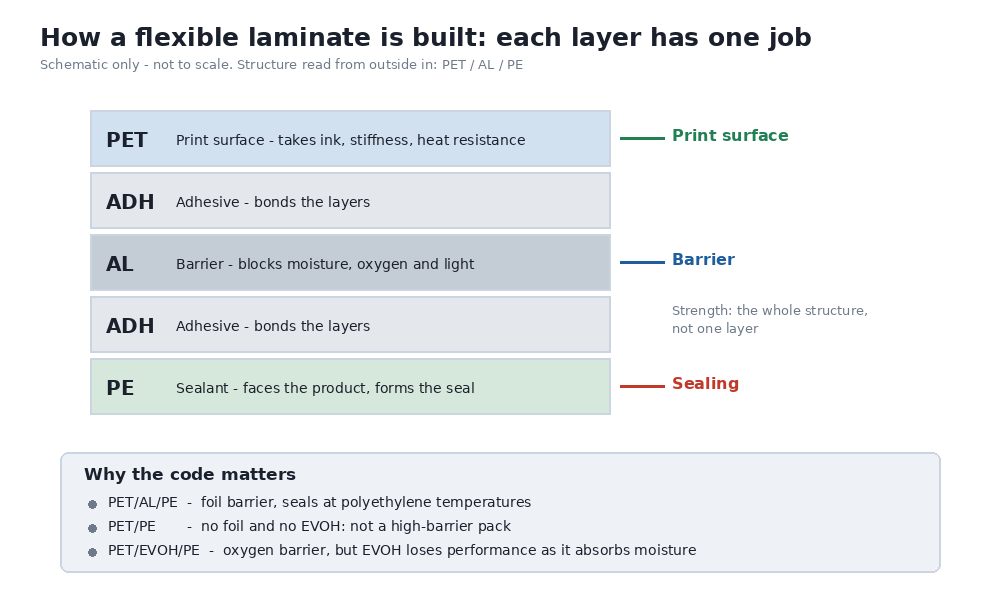
– Print surface: the outside layer must accept ink and protect the decoration. – Barrier: one or more layers must slow down moisture, oxygen, or light. – Strength: the structure must survive filling, transport, and the customer’s hands. – Sealing: the inside layer must form a strong, leak-free seal on your machine.
Each job usually belongs to a different layer. When you change one, you often change the others.
How to read a structure code
Converters write structures from the outside in, with slashes between layers. A common example is PET/AL/PE.
– PET is the outer print web. It gives stiffness, heat resistance, and a good printing surface. – AL is aluminium foil. It is the barrier layer. – PE is the sealant. It faces the product and forms the seal.
Once you can read the code, you can see the logic of a structure at a glance. If the last layer is PE, the pack seals at polyethylene temperatures. If the barrier layer is foil, the barrier is close to absolute. If there is no foil and no EVOH, the structure is not a high-barrier pack.
The sealant layer decides more than people expect
The sealant is the layer most often underestimated, and it controls several things at once:
– Seal initiation temperature, which sets how fast your machine can run. – Hot tack, which decides whether the seal holds while it is still warm and the pack is still under tension. – Minimum seal strength, which decides whether the pack survives distribution. – Product compatibility, because this is the only layer touching the contents.
Two structures can have identical barrier on paper and behave completely differently on the line, purely because the sealant differs. If you are troubleshooting a sealing problem, start here.
Barrier is not one property
“High barrier” is not a single specification. Different products need protection from different things.
– Moisture barrier is usually delivered by polyolefins, foil, or metallised films. – Oxygen barrier is delivered by EVOH, foil, or metallised layers. – Light barrier requires foil or a metallised layer, and opacity must be checked rather than assumed.
EVOH is an interesting case. It is an excellent oxygen barrier, but its performance drops sharply when it absorbs moisture. That is why it is normally buried between polyethylene layers instead of being placed against a wet product or a humid environment.
Choosing barrier is therefore a question about your product first, and about materials second.
How to verify a structure before you commit
A structure that looks right on paper should be proven before the print run. Useful checks include:
– Water vapour transmission rate, tested using ASTM F1249. – Oxygen transmission rate, tested using ASTM D3985. – Seal strength and seal initiation temperature, measured on your own sealing equipment. – Laminate bond strength, to confirm the adhesives are performing as intended – and, where a bond fails, a laminate bond and delamination investigation rather than a guess.
Testing on the actual filling line matters. A structure can pass every laboratory test and still fail in production because the machine’s seal conditions differ from the ones used in the trial.
Food contact compliance is a separate question
Barrier and strength are performance questions. Food contact is a legal one, and it is answered by documentation rather than by opinion.
In the United States, food-contact polymers are covered by FDA regulations under 21 CFR Part 177. In the European Union, plastic food-contact materials are covered by Regulation (EU) No 10/2011, supported by migration testing.
Two practical points follow:
– Ask for the declaration of compliance for the finished structure, not just for individual films. – Confirm that inks, adhesives, and coatings are also suitable for food contact, since a compliant film can still be turned into a non-compliant pack by the wrong ink.
When recyclability changes the answer
Conventional multi-material laminates perform very well in service. The difficulty is at end of life, because layers that are bonded together cannot be separated economically.
The industry response has been mono-material construction: all-polyethylene or all-polypropylene structures that fit existing film recycling streams. Orientation, such as machine direction oriented PE, recovers some of the stiffness and barrier that removing PET and foil would otherwise cost.
Two honest limits are worth stating:
– A mono-material pack is recyclable where that material is collected and sorted, and it is not where it is not. The claim belongs to a specific stream in a specific market. – For genuinely demanding duties, such as long shelf life or retort, mono-material may still fall short.
Design guidelines from RecyClass and CEFLEX give a workable baseline for assessing a structure, but they are a starting point for evaluation rather than a substitute for testing.
A short specification checklist
Before you approve a flexible packaging structure, confirm that you have:
– A written layer code, read from outside in. – The product’s real barrier requirements, not a generic high-barrier request. – Seal conditions tested on your own equipment. – A declaration of compliance for the finished laminate, including inks and adhesives. – The intended end-of-life route, and whether the structure genuinely fits it. – A pack-out trial result, not just a laboratory report.
Specifying flexible packaging is mostly a matter of asking the right questions in the right order. When the layers, the seal, and the compliance documents all line up, the print run is usually uneventful, which is exactly what a good specification is supposed to achieve.
Image credit: laminate structure diagram produced by J-Origin Packaging (own work).
Luna Luo, J-Origin Packaging
.