Intrinsically Safe Cameras: Why They Matter in Hazardous Areas
In industries where flammable gases, combustible dust, and volatile vapours are part of everyday operations, a single spark can trigger catastrophic consequences. This is the reality faced by professionals working in oil refineries, chemical plants, offshore platforms, grain storage facilities, and pharmaceutical manufacturing environments. Conventional cameras — no matter how robust — are simply not designed for these conditions. That is where intrinsically safe cameras come in, and it is where SharpEagle leads the way.
What Does “Intrinsically Safe” Mean?
The term intrinsically safe refers to a specific engineering protection concept applied to electrical equipment intended for use in explosive atmospheres. A device is classified as intrinsically safe when its design limits the electrical and thermal energy to levels too low to ignite a hazardous atmosphere — even under fault conditions.
This is not simply about rugged casing or sealed enclosures. Intrinsic safety is a fundamental design philosophy, governed by international standards such as IECEx and ATEX directives. Equipment carrying these certifications has been rigorously tested and verified to ensure it cannot become a source of ignition.
Key Distinction: Intrinsically safe equipment differs from explosion-proof equipment. Explosion-proof designs contain an explosion if one occurs inside the device. Intrinsically safe designs prevent ignition from happening in the first place — a fundamentally proactive safety approach.
Where Intrinsically Safe Cameras Are Essential
Any environment classified under Zone 0, Zone 1, or Zone 2 (gas) — or Zone 20, Zone 21, or Zone 22 (dust) — demands intrinsically safe imaging equipment. These environments include oil and gas refineries, chemical processing plants, offshore platforms, pharmaceutical facilities, grain and flour silos, battery manufacturing units, marine and shipyard environments, and paint or solvent factories.
It also applies to certain areas in the food and beverage industry, for example when food grade alcohol or products with high contents of alcohol, such as liquors or spirits are being filled, processed or produced.
In each of these settings, monitoring operations, inspecting pipelines, overseeing personnel safety, and conducting quality control all require reliable visual data. Intrinsically safe cameras deliver this capability without introducing any ignition risk whatsoever.
SharpEagle’s Certified Camera Solutions
At SharpEagle, we have built our reputation on delivering high-performance, certified vision systems engineered for the world’s most demanding hazardous locations. Our industrial grade cameras meet the exacting requirements of ATEX and IECEx standards, providing industrial operators with the confidence that every unit deployed is safe, reliable, and purpose-built for hazardous area classification.
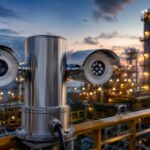
Our intrinsically safe camera range combines high-definition imaging with robust, corrosion-resistant housings that withstand harsh chemicals, extreme temperatures, and continuous operational pressure. Whether you need pan-tilt-zoom functionality for wide-area surveillance or fixed-mount cameras for monitoring critical process points, SharpEagle offers solutions tailored to your site’s specific zone requirements.
Explore our full range of certified hazardous area cameras — including detailed specifications, zone ratings, and compliance certifications — on our Explosion-Proof Digital Camera product page.
The Cost of Getting It Wrong
Some facility managers consider deploying standard industrial cameras in hazardous areas as a cost-saving measure. This decision can be devastatingly expensive. Regulatory fines for non-compliant equipment in hazardous zones are severe. More critically, an ignition event triggered by a non-certified camera can result in loss of life, permanent facility damage, and litigation that far exceeds any procurement savings.
The investment in properly certified intrinsically safe cameras is an investment in continuity of operations, workforce safety, and regulatory compliance. It is not optional — it is a legal and moral obligation for operators managing classified hazardous areas.
Choosing the Right Camera for Your Application
Selecting the correct intrinsically safe camera involves understanding several critical parameters: the zone classification of your environment, the type of hazardous substance present (gas, vapour, mist, or dust), the ambient temperature range, and specific operational requirements such as resolution, connectivity, and IP rating.
SharpEagle’s technical team works closely with clients to identify the ideal solution for each application. Every hazardous environment has its own combination of risks and operational demands. When evaluating intrinsically safe cameras, prioritise ATEX/IECEx dual certification, full HD or higher resolution, stainless steel or aluminium alloy housing, IP66/IP67 rating or above, integrated IR illumination for low-light environments, and PoE compatibility for simplified installation.
Conclusion
Intrinsically safe cameras are a necessity for any operation taking place in a classified hazardous zone. As the technology has matured, so too has the capability of these devices — delivering crisp imaging, intelligent connectivity, and rugged performance without ever compromising on zero ignition risk.
SharpEagle stands at the forefront of this technology, trusted by operators across oil and gas, chemical, pharmaceutical, and many other high-risk sectors worldwide. Ready to upgrade your hazardous area vision system? Connect with the SharpEagle team today for expert guidance and full compliance support.
website : https://www.sharpeagle.uk/product/explosion-proof-digital-camera
SharpEagle Technology
.