Explosion Proof Digital Camera for Oman Offshore Rigs
Offshore platforms in Oman’s Block 60 and Block 61 fields operate some of the most complex gas-processing infrastructure in the Middle East — and they do so in an environment that destroys uncertified equipment within months. Salt-laden air, constant vibration, extreme humidity, and hydrocarbon-rich atmospheres combine to create conditions that expose every piece of equipment your team carries to accelerated degradation and ignition risk simultaneously.
Standard cameras fail on both counts. The right explosion proof digital camera must be selected with the same rigour your procurement team applies to pressure vessels and safety valves — because in a classified marine or offshore environment, the camera is safety-critical equipment, not a consumable.
What Makes Offshore and Maritime Environments Different
Onshore hazardous areas are challenging. Offshore and maritime environments are categorically harder. The physical stresses are layered in ways that onshore procurement specifications rarely anticipate.
Saltwater exposure is the primary aggressor. Aerosol salt ingress degrades unprotected electronics rapidly — corroding contacts, compromising seals, and ultimately causing the kind of unpredictable electrical failures that are unacceptable in any flammable atmosphere. Beyond corrosion, the humidity levels aboard LNG carriers, at Oman’s marine terminal facilities in Duqm and Sohar, and on offshore platforms routinely exceed 90% relative humidity — conditions that accelerate oxidation and create condensation inside poorly sealed housings.
Vibration is less discussed but equally damaging. Offshore platforms transmit constant mechanical vibration through their structures; vessels at sea add wave-induced shock loading on top of that baseline. Equipment not designed for these conditions develops intermittent faults that are difficult to diagnose and often manifest as electrical events at the worst possible moment.
Then there is the atmosphere itself. Zone 1 and Zone 2 classifications aboard offshore platforms and LNG vessels reflect the reality that explosive atmospheres are not occasional occurrences — they are a structural feature of the operating environment. A digital camera explosion proof design addresses this directly. But the certification alone is not sufficient without the physical robustness to survive the environment long enough to deliver it.
The Certifications That Matter for Marine and Offshore Procurement
Certification selection for offshore and maritime procurement is more nuanced than for onshore applications. Your specification should confirm:
ATEX Directive 2014/34/EU Zone 1 certification — the baseline for equipment operating in areas where explosive gas atmospheres exist during normal operation. Zone 2 certification alone is insufficient for the majority of offshore platform classified areas
IECEx certification — mandatory for compliance under the HSE management systems of most international offshore operators active in Oman’s concession blocks
IPX8 waterproof rating — full immersion protection to at least 15 metres; IP6X dustproofing for particulate environments during maintenance shutdowns
Operating temperature range — devices must function reliably across the temperature differential between direct Gulf sun exposure (surface temperatures exceeding 60°C on uncovered deck areas) and air-conditioned control room storage
Drop and shock resistance — a minimum 2.1-metre drop rating accounts for the height from which equipment can reasonably fall during rig and vessel inspections
Chemical resistance — relevant for inspection roles near processing equipment handling hydrogen sulphide (H₂S), methanol, or glycol
An ex proof digital camera without IECEx certification will frequently fail vendor qualification for international offshore operators — regardless of its ATEX standing. Verify both before purchase.
SharpEagle Technology: Specification-Ready for Offshore Operations
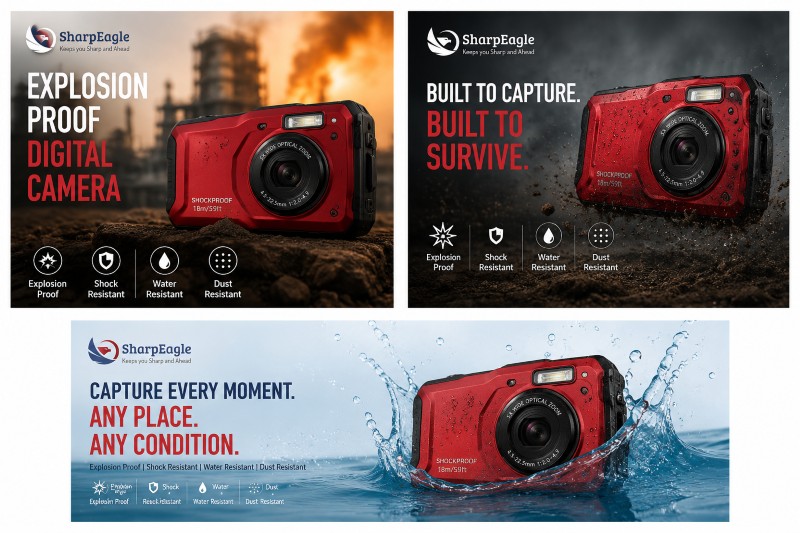
SharpEagle Technology’s explosion proof digital camera was developed with the operational demands of offshore and hazardous marine environments in its engineering DNA. The certification package — ATEX Zone 1 and Zone 2, IECEx, and chemical-specific approvals — positions it as one of the most comprehensively qualified portable imaging devices available to Oman-based offshore procurement teams.
The physical specification holds up under offshore scrutiny:
IPX8 waterproofing to 15 metres depth and IP6X dustproofing — built for spray decks, wash-down environments, and humid confined spaces aboard vessels
2.1-metre drop resistance — tested to survive the physical realities of inspection work on moving platforms
Freeze resistance to -10°C — relevant for night shift operations and cold-store inspections aboard refrigerated vessels
12-megapixel sensor with 4x optical zoom and explosion-proof LED flash — enabling detailed documentation in the low-light conditions typical of offshore module interiors, riser bases, and subsea access points
Battery life 2–3 times longer than standard mobile devices — a specification that becomes critical when your inspection team is working a 12-hour offshore shift without access to convenient charging infrastructure
Approximately 249g — light enough for sustained carry during extended inspection routes on platforms where technicians are already managing PPE, gas monitors, and hand tools
The ATEX digital camera certification scope means it can be used across Zone 1 and Zone 2 classified areas on the same platform visit — removing the operational friction of managing separate device specifications for different deck areas.
Offshore Inspection Workflows: Where Certification Meets Practice
Theory meets reality during a shutdown inspection on a gas compression platform. Your team has a six-hour window to document the condition of heat exchangers, pressure relief valves, pig launcher barrels, and electrical junction boxes across three hazardous decks. Every photograph taken in that window needs to be usable in a maintenance management system entry, an integrity management report, or, in the worst case, a regulatory submission.
An intrinsically safe camera design limits electrical energy at source rather than containing it within an explosion-proof enclosure. The practical result is a device that is lighter and more comfortable to carry during those extended offshore inspections — which directly affects how consistently your team actually uses it. Equipment that is awkward to carry gets put down. Equipment that gets put down does not generate the photographic record your asset integrity programme depends on.
Time-stamped imagery linked to equipment tag numbers and work orders also strengthens the audit trail that PUWER-aligned inspection regimes require. When your inspection record can show dated before-and-after imagery for every item on the planned maintenance schedule, the quality of your compliance documentation changes materially.
Conclusion
Offshore and maritime procurement decisions carry consequences that onshore equivalents rarely match — because the margin for equipment failure in a marine classified environment is essentially zero. The imaging devices your teams carry aboard Oman’s offshore platforms, LNG vessels, and marine terminal facilities should be selected with that reality at the centre of the specification process. As Oman’s offshore sector continues to expand and international operator HSE requirements grow more precise, the facilities that establish compliant imaging standards now will avoid the vendor qualification delays and regulatory complications that follow equipment shortfalls. For a comprehensive technical framework to guide that specification process, the Complete Guide to Explosion Proof Digital Cameras provides the depth your procurement team needs.
SharpEagle Technology
.