What a concentrated cleaner does to the refill pack itself
What a concentrated cleaner does to the refill pack itself
Refill formats are spreading through fabric care and home care, encouraged by regulation and by retailer targets. Most of the discussion around that shift is about the bottle, the concentrate and the consumer’s willingness to switch. Very little of it is about what the concentrate does to the pouch it arrives in, which is the part we see.
The chemistry decides the pack, not the format
A cleaning formula is not a neutral liquid. It is a designed system of surfactants, builders, solvents, preservatives and often bleach, at a pH chosen to make it work. Each of those choices interacts with the packaging materials it will sit against for the length of its shelf life.
That interaction is not visible on the day of filling. A pouch can seal cleanly, hold its weight, pass a drop test and leave the factory in perfect condition, and still fail on a shelf or in a warehouse months later. When that happens the packaging is usually blamed first and usually wrongly.
Bleach is the hardest case
Sodium hypochlorite is the most demanding common household ingredient to pack in flexible format, and it is worth understanding why.
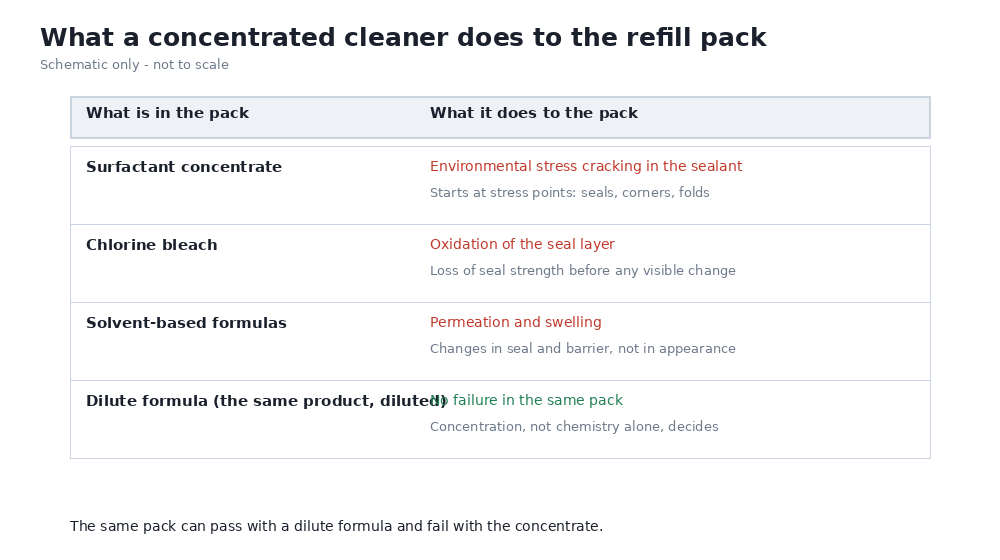
Hypochlorite is a strong oxidiser. Over time it attacks many sealants and many laminates’ adhesive layers, degrading the bond from the inside and reducing seal strength on a timescale measured in months rather than days. A structure that sealed perfectly at filling can show weakened seals or channel leaks well into shelf life, long after everyone has stopped looking at that batch.
There is no way to test for this in a single day. It requires an aged compatibility test: filled packs stored under representative conditions, tested at intervals across the intended shelf life. Anything shorter is a guess.
This is also a case where the barrier discussion is beside the point. The problem is not that the product escapes through the film. It is that the product is chemically attacking the structure holding it in.
Surfactant concentrates behave differently from dilute formulas
High-active concentrates put a much greater surfactant load against the sealant layer than a dilute ready-to-use product does. Two effects matter.
The first is plasticisation. Some surfactants migrate into polyethylene over time and soften it, which reduces seal strength and can change how the pack behaves under load.
The second is environmental stress cracking. A polyethylene pack under stress, in contact with an aggressive surfactant, can crack at a stress concentration – a fold, a corner, a seal edge – well below the load the material would otherwise carry. The crack often appears at a point that looks incidental and is in fact the result of a specific combination of stress, chemistry and time.
Both effects tend to show up in distribution rather than in the plant, because distribution is where the pack experiences sustained load.
Compatibility has to be tested on the finished pack
A film data sheet will tell you what a film does on its own. It will not tell you what a filled, sealed, printed pouch does, because the pouch is a composite system: sealant, adhesive, ink and any coating all sit in the same structure, and the product is in contact with the innermost layer and the seal area simultaneously.
Three practical consequences:
– Test the finished pack, not the film. A laminated pouch with a real seal and real product is the only meaningful sample – and where a pack fails in service, the underlying mechanism rather than the symptom. – Test the seal area specifically. It is the part of the pack that is both mechanically loaded and exposed to the product. – Test at intervals, not once. Compatibility problems are time-dependent, and a single result at day one proves very little about month twelve.
What we need from a brand, early
Five things change the answer completely and are often settled last:
– The active system, not just the product name. Whether bleach, a quaternary ammonium compound or an enzyme is present matters more than the marketing category. – The pH. It determines which sealants and adhesives are even candidates. – The fill temperature and the expected contact time before the pack is used. – The target shelf life and the storage conditions, since both are inputs to the compatibility test rather than outputs of it. – Whether the pack is a refill used immediately or a concentrate that sits on a shelf, because these are different problems.
Where refill genuinely pays off, and where it does not
Refill formats are usually better on material use, and that advantage is real. It is also easy to lose.
If a refill pack has to carry a heavier barrier structure than the bottle it replaces, or if it needs secondary packaging to survive distribution, or if the concentrate has to be diluted in a way that leads consumers to use more product than intended, then the benefit narrows considerably. The honest comparison is the whole system – pack, fill, distribution, use, and end of life – not the pack alone.
That comparison is worth making early, because it changes the structure, and the structure is the part that is expensive to change later.
Luna Luo is CEO of J-Origin Packaging, a flexible packaging and label manufacturer based in Shenzhen, China, producing printed flexible packaging, laminates, pouches and labels for household, personal care, food and consumer brands.
Image credit: refill pack compatibility schematic produced by J-Origin Packaging (own work).
Luna Luo, J-Origin Packaging
.