When Do Packaging Machine Parts Need an Extended End Mill?
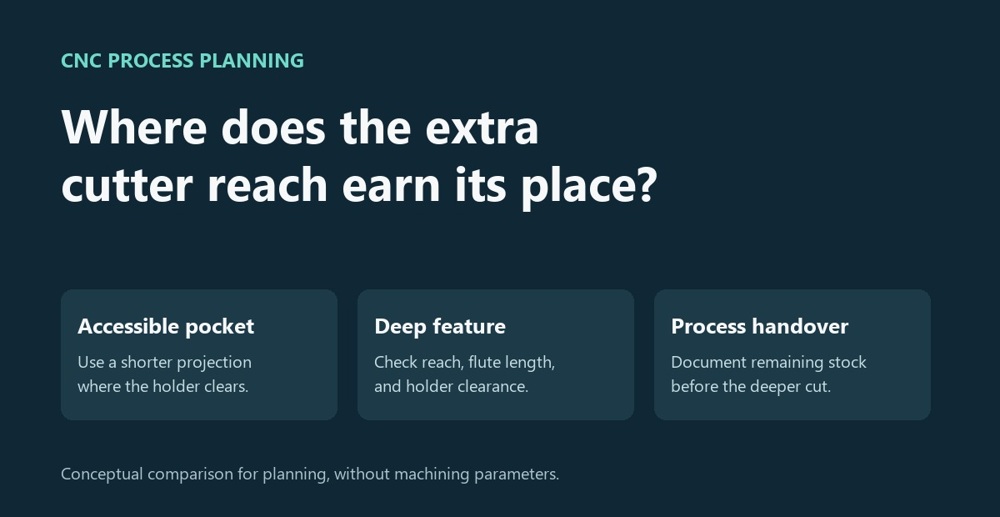
A steel change part for a packaging machine can have an open upper pocket and a narrow recess farther down. The recess may require an extended end mill, but that does not automatically make the same tool a good choice for the whole part. Before assigning one cutter to all operations, separate the features that need extra reach from those that can be machined with a shorter tool.
Define where the extra reach is needed
Consider a hypothetical steel mounting block for a packaging line. Its shallow pocket is accessible from above, but a small relief at the bottom sits beside a tall wall. Compare a sequence in which a short cutter clears the accessible stock and an extended cutter finishes the relief with a sequence that uses the extended cutter throughout. Include the time for tool changes and inspection, along with whether the finished geometry repeatedly meets the drawing.
Check cutting length and installed projection separately
Overall tool length, flute length and projection from the holder describe different dimensions. A cutter that is long enough overall can still leave the holder or shank too close to a wall or clamp. Review the tool drawing, holder outline and part geometry together. Show which part of the edge needs to engage and where the rest of the tool needs clearance.
For a reference when comparing tool drawings, see Yumiteck’s extended square carbide end mill for steel. Check the dimensions and flute configuration of the offered variant against the actual feature before specifying a tool.
Review the handover between the two operations
In the CAM review, inspect the stock remaining after the first tool finishes. Corners and transitions can retain more material than the finished model suggests. Record where the first cutter stops, which surfaces the second cutter will finish and how it approaches and retracts. When requesting application guidance, provide that stock condition along with the drawing and intended holder setup.
That review is especially useful when a packaging line depends on repeatable change parts. Assess the trial by the finished feature, inspection results and any operator intervention. Once the cut that actually needs the extra reach is identified, the team can judge the contribution of the extended cutter against the complete job.
Image credit: Original CNC process-planning illustration prepared for this article.
Yumiteck
.