Automated Packaging in Hygiene Product Manufacturing: Improving Efficiency, Quality, and Production Consistency
The hygiene products industry operates under demanding production requirements. Products such as baby diapers, adult incontinence products, sanitary products, and disposable wipes are manufactured in large volumes and must meet consistent standards for quality, hygiene, packaging integrity, and delivery.
As production capacity increases and product portfolios become more diverse, packaging has become an increasingly important part of manufacturing operations. It is no longer simply the final step before products leave the production line. Packaging affects production efficiency, product protection, inventory management, transportation, and the overall customer experience.
Automated packaging systems help manufacturers manage these requirements by reducing repetitive manual operations, improving packaging consistency, and connecting different stages of production. From product counting and stacking to bagging, sealing, inspection, and palletizing, automation can support a more controlled and efficient manufacturing process.
For hygiene product manufacturers, the challenge is not simply to install faster packaging equipment. It is to develop a packaging system that can accommodate different product specifications, packaging formats, production volumes, and quality requirements while maintaining operational flexibility.
1. Why Packaging Automation Matters in Hygiene Product Manufacturing
Hygiene products are often produced in high volumes, making packaging efficiency an important factor in overall production performance.
Traditional manual packaging operations may involve several repetitive tasks, including product counting, folding, stacking, bag loading, sealing, labeling, and carton handling. When these tasks depend heavily on manual labor, production consistency can become difficult to maintain, particularly during periods of high demand.
Packaging automation addresses several common manufacturing challenges.
1.1 Improving Production Efficiency
Automated packaging equipment can perform repetitive operations at a consistent speed. Products can move through counting, grouping, bagging, and sealing processes with fewer manual handling steps.
This helps manufacturers reduce interruptions between production and packaging, particularly when equipment is properly integrated with upstream production lines.
Automation also allows employees to focus on equipment monitoring, quality checks, material preparation, and process management rather than performing every packaging task manually.
1.2 Maintaining Packaging Consistency
Consistent packaging is important for both retail presentation and product protection.
Differences in package dimensions, product arrangement, sealing quality, and labeling can affect the appearance and usability of finished products. Automated systems use predefined operating parameters to help maintain more consistent results across production batches.
For products such as baby diapers and adult incontinence products, consistent package presentation also helps brands maintain a recognizable appearance across different sizes and product variants.
1.3 Reducing Manual Handling
Frequent manual handling can increase the risk of product displacement, packaging damage, and inconsistent product arrangement.
Automated transfer and packaging systems help reduce unnecessary contact with finished products. This can support cleaner and more controlled operations, provided that equipment design, maintenance, and hygiene procedures are properly managed.
1.4 Supporting Large-Volume Production
Manufacturers serving multiple markets often need to handle substantial production volumes and different packaging specifications.
Automated packaging lines can support continuous operations and help manufacturers coordinate production output with downstream packaging capacity. This is particularly important when several product categories share the same manufacturing facility.
However, automation does not automatically eliminate production bottlenecks. Packaging capacity must be matched with the output of upstream equipment, material supply, and warehouse operations.
2. Key Stages of an Automated Hygiene Product Packaging Line
An automated packaging line typically consists of several connected processes. The exact configuration depends on the product category, package format, production capacity, and required level of automation.
2.1 Product Transfer and Initial Inspection
After products are manufactured, they need to be transferred from the production line to the packaging area.
Conveyor systems and automated transfer equipment can move products between different processing stages while reducing manual transportation.
At this stage, manufacturers may also conduct preliminary checks to identify visible defects, misplaced products, or irregularities before packaging.
The inspection process may involve manual sampling, sensors, or machine vision systems, depending on the production requirements.
2.2 Product Counting, Folding, and Stacking
Before products enter packaging, they generally need to be arranged according to the required package quantity and configuration.
For example, baby diapers and adult diapers are commonly packaged in predetermined quantities. Automated counting and stacking equipment can organize products into consistent groups before they enter the bagging stage.
Depending on the product design, folding and compression mechanisms may also be used to achieve the required package dimensions.
Accurate counting is particularly important because incorrect package quantities can lead to customer complaints, inventory discrepancies, and additional inspection costs.
2.3 Automatic Bag Feeding and Loading
Once products have been grouped, they can be transferred into packaging bags.
Automated bagging systems may include bag feeding mechanisms, opening devices, product loading units, and transfer equipment.
The equipment needs to accommodate the dimensions and material characteristics of the packaging. Different product sizes and package configurations may require adjustments to the machine settings.
For hygiene products sold under different brands or private-label programs, packaging flexibility is especially important. Manufacturers may need to manage multiple bag sizes, printed designs, and product quantities within the same production environment.
2.4 Sealing and Packaging Integrity Inspection
After products are loaded into bags, the packaging is sealed to protect the contents during storage and transportation.
Sealing quality is a critical control point. Inadequate sealing, wrinkles, contamination, or damage to the packaging material can compromise package integrity.
Automated sealing equipment helps maintain more consistent operating conditions, including temperature, pressure, and sealing time where applicable.
Additional inspection methods can be used to identify visible packaging defects. Depending on the application, manufacturers may also conduct sampling tests to verify sealing strength and package integrity.
2.5 Finished Product Handling and Carton Packing
After sealing, finished packages may be transferred to carton packing stations.
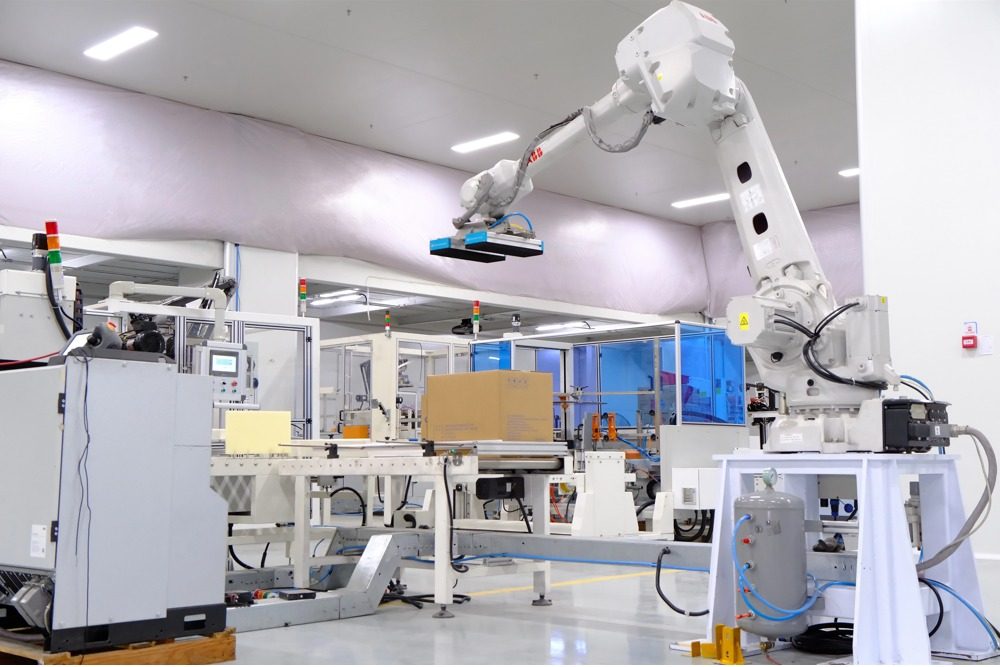
Automated carton handling systems can support carton forming, product loading, carton closing, and labeling. Some operations may also use robotic systems to arrange cartons for palletizing.
The goal is to maintain a smooth flow from individual product packaging to warehouse-ready cartons.
When these processes are integrated effectively, manufacturers can reduce unnecessary handling and improve coordination between packaging and finished-goods storage.
3. Packaging Materials and Their Impact on Automation
Packaging automation is not determined by machinery alone. Packaging materials also influence equipment performance, production stability, and finished-product quality.
Hygiene products commonly use flexible packaging materials designed to protect products from external contamination, moisture, dust, and handling damage.
3.1 Flexible Plastic Packaging
Plastic film and flexible bags are widely used for disposable hygiene products because they can accommodate different package sizes and product configurations.
The material needs to be compatible with the packaging equipment. Film thickness, flexibility, sealing characteristics, and surface properties can all influence machine performance.
If packaging material dimensions or characteristics vary significantly, automatic feeding and sealing operations may become less stable.
Manufacturers should therefore evaluate packaging materials together with the equipment specifications rather than treating them as separate purchasing decisions.
3.2 Printed Packaging
Printed packaging plays an important role in product identification and brand presentation.
For private-label products, packaging may need to display different brand identities, product specifications, size information, and market-specific labeling.
Automation systems should be capable of supporting the required packaging dimensions and changeover procedures.
Clear coordination between brand owners, packaging designers, material suppliers, and manufacturers can help reduce errors during packaging changes.
3.3 Cartons and Secondary Packaging
Secondary packaging protects individual product packages during storage and transportation.
Carton dimensions, strength, and stacking requirements should be considered when designing the complete packaging process.
Poor coordination between primary packaging and carton specifications can result in inefficient use of storage space or transportation capacity.
For this reason, packaging design should consider the full supply chain rather than focusing only on the appearance of the individual retail package.
4. Integrating Packaging Automation with Quality Management
Automation can improve process consistency, but it does not replace a comprehensive quality management system.
Hygiene product manufacturers need to establish quality controls across raw materials, production, packaging, and finished-goods handling.
4.1 Establishing Packaging Quality Standards
Before implementing automated packaging equipment, manufacturers should define measurable packaging requirements.
These may include:
– Package dimensions and weight.
– Product quantity per package.
– Product arrangement and folding consistency.
– Sealing appearance and integrity.
– Printed information and labeling accuracy.
– Carton specifications and packing quantities.
Clearly defined standards make it easier to configure equipment, inspect finished packages, and identify deviations.
4.2 Using Automated Inspection Technologies
Machine vision systems, sensors, and other inspection technologies can support the detection of certain packaging defects.
Depending on the system configuration, these technologies may help identify incorrect product positioning, missing items, visible package damage, or printing irregularities.
However, inspection systems have limitations. Their effectiveness depends on camera resolution, lighting conditions, detection algorithms, product variation, and equipment maintenance.
Manufacturers should validate inspection performance under actual production conditions and combine automated detection with appropriate manual checks and sampling procedures.
A structured approach to [quality management and inspection processes](https://www.easyhygienic.com/quality) can also help manufacturers define inspection responsibilities, document results, and manage corrective actions throughout production.
4.3 Connecting Packaging Data with Production Management
Modern manufacturing operations increasingly rely on digital systems to monitor production performance.
When packaging equipment is connected to manufacturing execution systems or other production management platforms, manufacturers may be able to collect information such as:
– Production output and packaging quantities.
– Equipment operating status.
– Downtime and interruption records.
– Product changeover information.
– Inspection results and rejected packages.
– Material consumption and packaging efficiency.
This information can help production teams identify recurring problems and improve process planning.
For example, repeated packaging interruptions may indicate problems with material feeding, equipment settings, or upstream production synchronization. Production data can help narrow down the potential causes.
A connected manufacturing environment, supported by systems such as manufacturing execution and warehouse management platforms, can provide better visibility across production and material flows. Examples of these approaches can be seen in modern [smart factory operations](https://www.easyhygienic.com/smart-factory).
5. Challenges in Implementing Automated Packaging Systems
Although automation offers operational advantages, implementation requires careful planning.
A packaging system that performs well for one product configuration may not be suitable for another. Hygiene product manufacturers must consider product diversity, production volumes, equipment compatibility, and long-term operating costs.
5.1 Managing Different Product Specifications
Baby diapers, adult diapers, incontinence pads, and disposable wipes have different dimensions, shapes, and packaging requirements.
Even products within the same category may have different sizes, absorbency specifications, package quantities, and bag dimensions.
Manufacturers should evaluate whether packaging equipment can accommodate these variations without excessive manual adjustments or long changeover times.
Flexible equipment is particularly valuable for facilities that handle multiple product categories or private-label orders.
5.2 Balancing Automation Investment and Production Needs
Automated packaging equipment requires capital investment, installation, maintenance, and employee training.
A higher level of automation does not necessarily provide the best return for every production operation.
Manufacturers should evaluate expected production volumes, labor requirements, equipment utilization, maintenance costs, and potential reductions in packaging defects.
A phased implementation strategy may be more practical than replacing every manual process at once.
5.3 Equipment Integration and Compatibility
Packaging equipment needs to work with upstream production machinery and downstream logistics operations.
If the production line generates products faster than the packaging equipment can process them, bottlenecks may occur.
Similarly, equipment with different control systems or operating speeds may require additional integration work.
Before purchasing new machinery, manufacturers should review line capacity, transfer methods, control interfaces, product specifications, and available factory space.
5.4 Maintenance and Technical Training
Automated systems depend on regular maintenance and qualified operators.
Poor maintenance can lead to unexpected downtime, inconsistent packaging performance, and increased repair costs.
Employees need appropriate training in machine operation, troubleshooting, safety procedures, and routine maintenance.
Manufacturers should also establish preventive maintenance schedules and maintain records of equipment performance.
6. How Manufacturers Can Evaluate Packaging Automation Solutions
Choosing packaging equipment should begin with an assessment of actual production requirements rather than selecting machinery based only on advertised speed or automation level.
The following considerations can help manufacturers evaluate potential solutions.
| Evaluation area | Key considerations |
|—|—|
| Product compatibility | Can the equipment handle different product sizes, shapes, and configurations? |
| Packaging formats | Does it support the required bag materials, dimensions, and carton formats? |
| Production capacity | Can the equipment match the output of upstream production lines? |
| Changeover flexibility | How easily can operators switch between product sizes and packaging specifications? |
| Quality control | What inspection and rejection functions are available? |
| System integration | Can the equipment communicate with existing production and management systems? |
| Maintenance | Are spare parts, technical support, and maintenance services available? |
| Total operating cost | What are the costs of installation, labor, energy, maintenance, and downtime? |
Manufacturers should also request equipment demonstrations or production trials whenever possible.
Testing with actual products and packaging materials can reveal practical limitations that may not be apparent from equipment specifications alone.
In addition, the evaluation should consider future production plans. Equipment designed only for current demand may become a constraint if product volumes or packaging requirements change.
7. The Role of Automation in Supporting Private-Label Hygiene Products
Private-label manufacturing has become an important part of the global hygiene products market.
Brand owners and importers may require customized product specifications, package quantities, printed designs, and labeling for different markets.
These requirements create additional complexity for manufacturing and packaging operations.
Automated packaging systems can help manufacturers manage repeatable processes while maintaining flexibility for different customer orders.
For example, standardized counting and sealing operations can support consistent package quantities, while adjustable packaging equipment can accommodate different bag sizes and product configurations.
For manufacturers such as Easy Hygienic, which focuses on [baby care products](https://www.easyhygienic.com/products/baby-care) and [adult incontinence products](https://www.easyhygienic.com/products/incontinence-care), packaging consistency is an important consideration when serving international brands and private-label customers.
In this manufacturing sector, packaging operations need to support not only production efficiency but also product protection, quality management, and the specific requirements of different product categories.
However, automation alone does not guarantee successful private-label production. Manufacturers still need effective order planning, accurate packaging specifications, reliable material management, and clear communication with customers.
8. Future Trends in Automated Hygiene Product Packaging
As manufacturing technologies continue to develop, packaging systems are expected to become more connected, adaptable, and data-driven.
Several trends are likely to influence future packaging operations.
8.1 Greater Use of Machine Vision
Machine vision technologies are becoming increasingly important in automated inspection.
Improved imaging and detection systems may help manufacturers identify packaging defects more consistently and reduce reliance on repetitive manual inspection.
The practical value of these systems will depend on their ability to detect defects accurately under real production conditions.
8.2 More Connected Production Systems
Integration between packaging equipment, production management platforms, and warehouse systems can provide manufacturers with better visibility into production activities.
More connected systems may support improved scheduling, material tracking, equipment monitoring, and finished-goods management.
This can help manufacturers make decisions based on actual production data rather than relying entirely on manual reporting.
8.3 Flexible and Modular Packaging Equipment
Product portfolios and customer requirements continue to evolve.
Modular packaging systems may offer manufacturers more flexibility when introducing new products, adjusting package quantities, or changing packaging formats.
Rather than redesigning an entire production line, manufacturers may be able to modify selected equipment modules to meet changing requirements.
8.4 Greater Attention to Packaging Material Efficiency
Material efficiency is another important consideration for the future of packaging.
Manufacturers are increasingly evaluating ways to optimize film usage, reduce packaging waste, and improve carton utilization.
However, material reduction must be balanced with product protection, sealing performance, transportation requirements, and applicable packaging regulations.
The objective is to improve material efficiency without compromising packaging integrity.
Conclusion
Automated packaging plays an increasingly important role in modern hygiene product manufacturing. By connecting product transfer, counting, stacking, bagging, sealing, inspection, and finished-goods handling, manufacturers can improve production coordination and maintain more consistent packaging operations.
However, successful automation requires more than purchasing advanced machinery. Manufacturers need to evaluate product specifications, packaging materials, production capacity, equipment compatibility, quality standards, and long-term operating costs.
For companies producing baby care and adult incontinence products, the ability to manage different product categories and packaging requirements is particularly important.
As automation, machine vision, and production management technologies continue to develop, manufacturers that combine suitable equipment with effective quality management and flexible production planning will be better positioned to meet the changing needs of the global hygiene products market.
The most effective packaging strategy is not necessarily the one with the highest level of automation. It is the one that supports reliable production, consistent quality, and practical operational efficiency over the long term.
TITA
.