The Orifice Reducer Fits the Bottle. But Will It Stay in Place?
# The Orifice Reducer Fits the Bottle. But Will It Stay in Place?
An orifice reducer is one of the smallest components in an essential oil packaging system. It may look like a simple plastic insert, but its position inside the glass bottle neck plays an important role in how the package dispenses liquid.
During sample evaluation, a reducer may slide into the bottle opening without difficulty. The cap screws on, the bottle looks properly assembled, and the packaging appears ready for use.
But an important question remains: will the insert stay in place when the consumer opens the bottle?
For essential oil brands and packaging buyers, a successful initial fit is only the beginning. The reducer must also reach its intended seating position, remain appropriately retained, and work with the cap throughout the product’s expected use.
## When a Small Insert Comes Out With the Cap
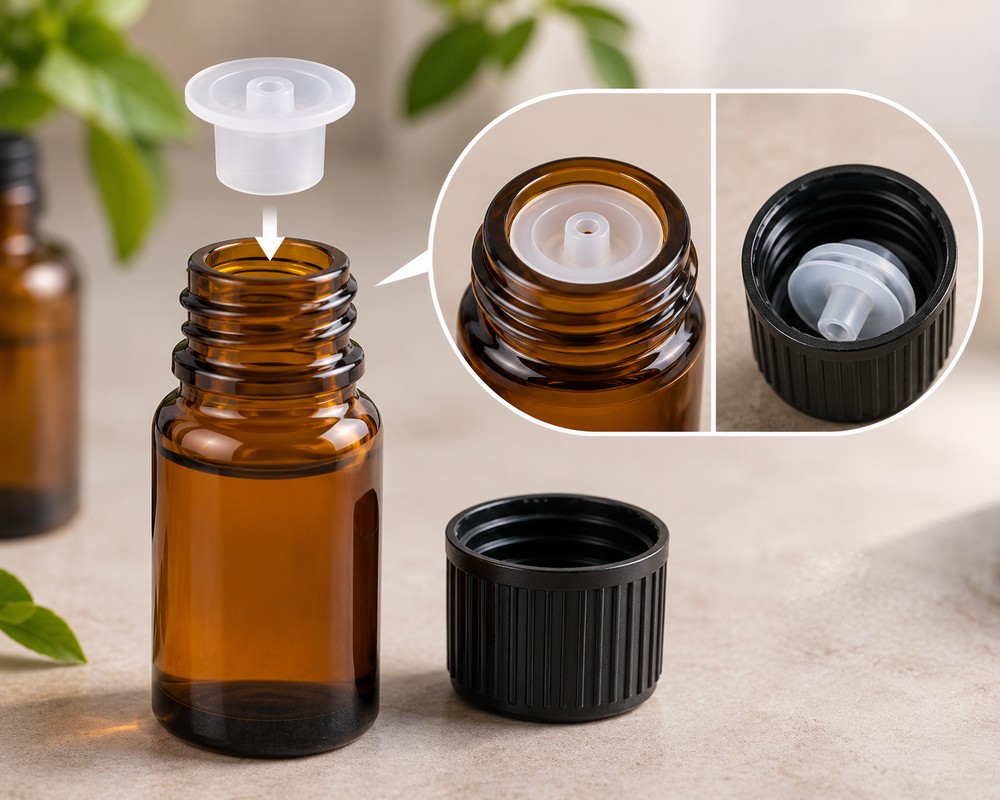
Euro dropper bottles commonly use an orifice reducer to control how liquid leaves the container.
When the bottle is tilted or inverted, liquid passes through a small dispensing opening. Depending on the design, a separate air-return passage helps support controlled flow.
Unlike a pipette dropper, the consumer does not need to squeeze a rubber bulb.
The insert should normally remain in the bottle neck while the cap is removed for dispensing.
However, some essential oil users have reported finding the plastic insert inside the cap after opening a bottle.
A January 2026 discussion in Reddit’s r/essentialoils community included an account of a reducer becoming stuck inside the cap of a newly opened frankincense essential oil bottle.
That observation does not establish a widespread manufacturing problem. It does, however, raise a useful packaging question.
**Why can a component that fits the bottle neck fail to remain in its intended position?**
The answer begins with the distinction between installation, seating, and retention.
## Installation, Seating, and Retention Are Not the Same
These three terms describe different aspects of component performance.
**Installation** refers to whether the reducer can be placed into the bottle using its intended assembly method.
**Seating** refers to whether the reducer reaches the correct position relative to the bottle neck and its contact surfaces.
**Retention** refers to whether the installed reducer remains sufficiently secure under the expected handling and use conditions.
A reducer may enter the bottle opening easily but stop before reaching its intended seating depth.
Another may appear level with the rim while its retaining features have not engaged as designed.
A third may be correctly installed initially but become displaced when the cap is removed.
These conditions should not be treated as the same problem.
A tighter fit is not automatically better, either. Excessive insertion force can introduce assembly difficulties, distort plastic components, or create inconsistent results.
The objective is not maximum resistance. It is a correctly specified fit that can be installed consistently and remain functional.
## Why Glass Neck Geometry Matters
The glass bottle neck provides the surfaces that locate and retain the reducer.
Several geometric details influence how the components interact.
### Internal Diameter and Contact Surfaces
A reducer’s retaining features must match the relevant inner dimensions of the bottle neck.
If the insert is too small for the available contact region, engagement may be insufficient. If the fit is excessively tight, installation may become difficult or place unnecessary stress on the components.
The actual relationship depends on the specific design.
A bottle’s nominal capacity is not enough to determine compatibility.
Two essential oil bottles labeled 10 ml may have different internal neck structures, even when their external appearances are similar.
The matching bottle and reducer specifications are therefore more useful than capacity alone.
### Seating Depth and Internal Support
Some reducer designs use a flange, rib, or other locating feature to position the component within the bottle opening.
The intended seating depth determines which surfaces engage and how the insert is supported.
A reducer that appears flush with the bottle rim is not necessarily installed correctly unless that position agrees with the specified design.
Visual appearance should be interpreted alongside the relevant component drawing or assembly requirements.
### Dimensional Tolerances
Glass bottles and molded plastic components are produced with dimensional variation.
Even when both components meet their individual specifications, their combined fit can vary.
For example, an insert near one end of its permitted dimensional range may engage differently with a bottle neck near the opposite end of its range.
This is known as a tolerance interaction.
It explains why one successful sample cannot always represent every component combination delivered in a larger order.
For packaging development, evaluating the intended range of component dimensions is more informative than relying on a single well-fitting pair.
## The Cap Has a Bigger Role Than It Appears
In some Euro dropper systems, the orifice reducer is initially positioned inside the cap.
When the closure is screwed onto the bottle, the cap pushes the insert into the glass neck. After the cap is removed, the insert is intended to remain seated.
Other systems use separate insertion equipment or manual installation.
These different arrangements create different assembly requirements.
In a cap-assisted installation system, the closure must guide the insert into the correct position.
If the insert is tilted, only partially seated, or interacting with an unintended cap surface, the assembly may not perform as expected.
The relationship also matters during opening.
The cap should separate from the installed reducer according to the intended design, rather than unexpectedly extracting it.
This means the cap and reducer should be evaluated together.
A bottle that looks correctly assembled while closed may reveal a retention issue during the first opening.
At the same time, finding an insert inside a cap before the initial installation does not necessarily indicate a defect. That position may be intentional in a cap-assisted assembly system.
Understanding the intended installation method is essential before diagnosing a problem.
## Can Essential Oil Formulations Affect Insert Retention?
The reducer is usually manufactured from a polymer material selected for the intended packaging application.
However, chemical compatibility cannot be established from a generic material name alone.
Essential oil formulations can contain different mixtures of fragrance constituents and carrier ingredients.
The way those substances interact with a plastic component depends on the actual polymer grade, formulation composition, exposure duration, and storage temperature.
Under certain conditions, incompatible material combinations may experience swelling, softening, or dimensional changes.
Such changes could affect fit and retention, but they should not be assumed without appropriate evidence.
Glass compatibility and plastic compatibility are also separate questions.
A formulation that performs acceptably in a glass bottle may still require additional assessment when it contacts the reducer, cap liner, or other closure components.
For this reason, the final filled packaging configuration should be evaluated with the actual intended formulation.
## What Happens When the Reducer Moves Out of Position?
A displaced reducer can affect the package in several ways, depending on its construction.
### Dispensing Behavior
The reducer’s opening helps control how liquid exits the bottle.
If the component moves away from its intended position, the dispensing path may change.
That may affect the user’s ability to obtain controlled drops.
### Handling and Product Exposure
If the reducer comes out completely, the bottle may have a larger exposed opening when the cap is removed.
This can make accidental pouring or spilling more likely during handling.
A loose reducer may also be difficult to reinstall correctly after the bottle has been filled.
### Closure Performance
Retention and sealing should not be confused.
An insert remaining in place does not automatically prove that the closed bottle is leakproof.
Depending on the design, liquid-tight sealing may rely on separate closure surfaces, liners, or other interfaces.
Similarly, an insert becoming displaced during opening does not necessarily mean the bottle was leaking while closed.
**Retention, dispensing, and sealing are related but distinct performance requirements.**
Identifying which function is affected helps prevent unnecessary changes to otherwise suitable components.
## Why a Perfect Sample May Not Represent a Production Order
A sample that fits correctly is useful evidence, but it is not the entire approval process.
During larger production runs, components may fall at different positions within their allowed dimensional ranges.
Assembly conditions may also vary.
In manual assembly, an operator may notice an insert requiring unusual force or appearing tilted.
In a filling and capping operation, the equipment must be set up to install the selected component consistently.
Potential concerns include incomplete insertion, misalignment, damage during handling, and closure application conditions that differ from those used for the original sample.
For buyers, this creates an important distinction:
A sample demonstrates that a particular combination can work.
A controlled production configuration requires component specifications, assembly requirements, and acceptance criteria that can be applied consistently.
The relevant question is not simply whether the first sample looked correct.
It is whether the approved packaging configuration can be reproduced using the components and assembly process selected for production.
## Selecting a Complete Euro Dropper Packaging Configuration
Rather than selecting the glass bottle, plastic reducer, and cap independently, packaging buyers can begin with a coordinated component combination.
Glass packaging manufacturers such as [FOLOVER PACK](https://www.foloverpack.com/) provide essential oil bottle options and related component-matching support that can be considered during package development.
The important consideration is whether the selected bottle neck, reducer, and closure have been specified to function together.
A coordinated configuration provides a more useful starting point than choosing an insert based only on its appearance or nominal bottle capacity.
However, component matching at the sourcing stage does not replace verification with the intended formulation and assembly conditions.
## A Practical Sample Evaluation Before Bulk Ordering
A meaningful sample evaluation should reflect how the finished package will be assembled and used.
The following checks can help packaging buyers organize the approval process.
### 1. Identify the Exact Components
Record the bottle model, neck specification, reducer design, polymer material, and cap configuration.
Do not approve a reducer solely because it appears to fit a bottle of the same nominal capacity.
### 2. Confirm the Installation Method
Determine whether the reducer is installed separately or through cap application.
The required equipment, handling conditions, and assembly instructions should match the intended design.
### 3. Inspect the Seating Position
Check whether the reducer has reached its specified position without visible tilting, damage, or incomplete engagement.
Where appropriate, use dimensional or assembly criteria rather than appearance alone.
### 4. Observe Cap Removal
Remove the cap from representative assembled samples and confirm that the reducer remains in its intended position.
Where repeated opening is expected, consider additional opening and closing observations under defined conditions.
### 5. Evaluate Dispensing With the Actual Formula
Check the dispensing behavior using the intended liquid.
An insert that remains mechanically secure is not necessarily suitable for the required drop formation or flow characteristics.
### 6. Review Material Compatibility
Consider the actual contact materials, formulation, storage conditions, and expected product life.
Where material compatibility is uncertain, agree on an appropriate evaluation method.
### 7. Establish Acceptance Criteria
Define what is acceptable for installed position, retention, dispensing behavior, and closure performance.
If a numerical retention requirement is necessary, it should be based on an agreed measurement method and product requirements rather than an arbitrary force value.
These are recommended packaging development checks, not claims of completed testing by a particular manufacturer.
## Seven Questions Worth Asking Before Approving the Packaging
A packaging buyer can clarify several important details before confirming a production order:
1. Is the reducer designed for the exact glass bottle neck being purchased?
2. What is the intended installation method?
3. How can correct seating be identified?
4. Does the cap install or interact with the reducer during opening?
5. Which component materials will contact the formulation?
6. How will assembled samples be evaluated before production?
7. Will the production components match the approved specifications and configuration?
These questions are more informative than asking only whether the reducer fits.
They help define the package as a complete system rather than a collection of independently purchased components.
## The Right Fit Must Continue Beyond Assembly
An orifice reducer that can be pressed into a glass bottle neck has passed only the first part of the packaging evaluation.
Its installed position, retention behavior, dispensing function, and interaction with the cap still need to be considered.
The actual formulation and production assembly method add further requirements.
For essential oil brands and packaging buyers, the most dependable decision is based on the complete bottle, reducer, cap, and intended contents.
**The real test of a reducer is not simply whether it fits during assembly, but whether it remains in the right place and performs its intended function throughout use.**
Andy
.