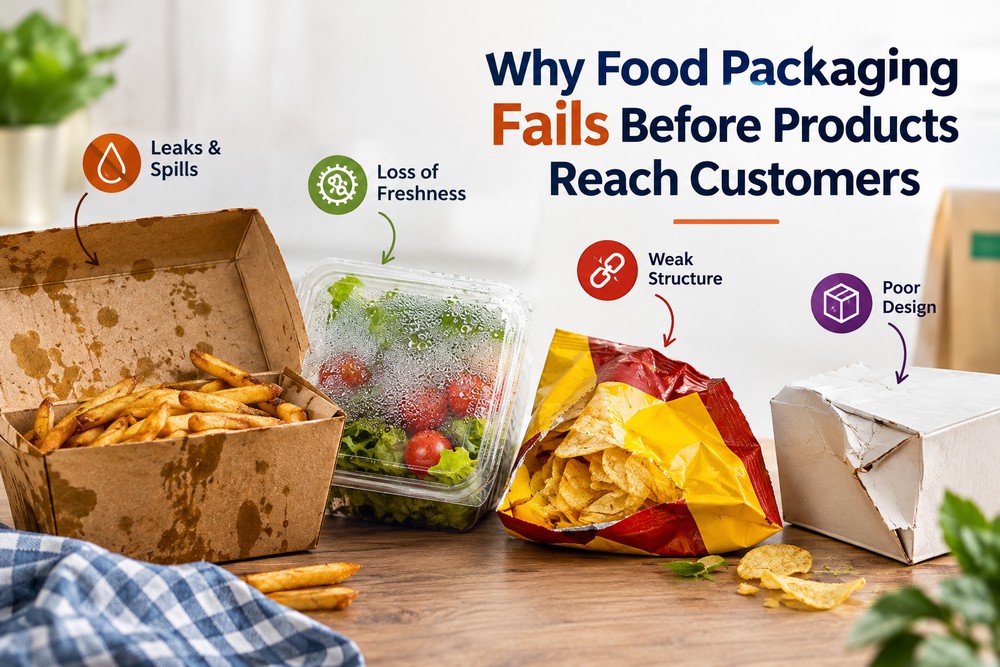
Why Food Packaging Fails Before Products Reach Customers
Food products can leave a factory or restaurant in excellent condition and still arrive at their destination damaged, leaking, crushed, or less appealing than expected. In many cases, the problem is not the food itself but the packaging selected to protect it. A container that works well in a storage room may not withstand stacking, movement, temperature changes, or repeated handling during delivery.
For Custom Food Boxes
manufacturers, takeaway businesses, bakeries, and retailers, packaging failures can lead to wasted products, customer complaints, replacement costs, and lost sales. Even a small weakness can become a larger problem when products travel through several stages before reaching the customer. Understanding why packaging fails helps businesses make better decisions before problems affect their operations.
Why Food Packaging Problems Often Start Before Delivery
Packaging failures are not always caused by careless handling during transportation. Some begin much earlier, when a business chooses a container without considering the product’s weight, moisture content, temperature, or storage requirements.
For example, a lightweight box may be suitable for dry bakery items but struggle to support heavier products during stacking. Similarly, packaging designed for dry food may not perform well when exposed to grease, condensation, or sauces.
Businesses need to evaluate the entire journey of a product rather than judging packaging by its appearance alone. A box that looks strong on a shelf may behave differently when several boxes are stacked together or when a delivery package is moved repeatedly.
Testing packaging with the actual food product can reveal weaknesses before large quantities are purchased or used.
Weak Materials Can Lead to Crushed or Damaged Products
One of the most visible packaging failures is structural damage. Boxes may bend under pressure, lose their shape, or collapse when heavier packages are placed on top of them. This can affect the appearance of food and, in some cases, expose the contents to contamination.
The problem often occurs when packaging materials are selected mainly on price without considering the weight and dimensions of the product. A box intended for a small pastry, for instance, may not be suitable for a large meal or a group of takeaway items.
To reduce these problems, businesses should consider:
- Product weight: The packaging must support the contents without bending or losing its shape.
- Stacking pressure: Boxes should remain stable when stored or transported together.
- Box dimensions: Excessive empty space can allow products to move during transit.
- Handling conditions: Packaging should withstand the normal movements and pressure expected throughout delivery.
The objective is not to choose the thickest or most expensive material. It is to select a suitable structure that provides sufficient protection without unnecessary material use.
Moisture, Grease, and Heat Can Weaken Packaging
Food packaging must work with the physical properties of the product it contains. Moisture, oil, steam, and temperature can affect packaging performance, particularly when the material is not designed for those conditions.
Hot food releases steam, which may collect inside a closed container. This can soften certain materials and change the texture of foods that are meant to remain crisp. Greasy foods can also leave marks or weaken unsuitable paper-based packaging.
Different food products require different approaches. A container suitable for dry cookies may not be appropriate for fried food, saucy meals, or freshly baked items.
Businesses should assess three important factors:
Moisture control: Packaging should manage moisture appropriately for the food. Some products require a moisture barrier, while others need ventilation to help prevent condensation.
Grease resistance: Food with a high oil content may require materials or coatings designed to resist grease penetration.
Temperature suitability: Packaging must be appropriate for the temperatures it will encounter during filling, storage, and delivery.
Choosing packaging according to the food’s actual requirements can help maintain product quality and reduce complaints.
Poor Sealing Can Cause Leaks and Contamination Risks
A package may look secure while still having a weak closure. Loose lids, incomplete seals, damaged seams, and unsuitable closures can allow liquids to escape or expose food to external contaminants.
These problems are particularly serious for sauces, soups, beverages, and ready-to-eat meals. A leaking container can damage other items in the same delivery bag, create additional cleaning work, and leave customers dissatisfied with the entire order.
Businesses using sealed pouches, trays, cups, or other containers should check whether closures remain secure under normal handling conditions. Packaging should also be compatible with the food and the filling process.
Useful checks include:
- Inspecting closures for gaps, wrinkles, or visible damage.
- Testing filled packages in realistic transport conditions.
- Checking whether lids remain secure when containers are moved.
- Reviewing recurring leakage complaints to identify patterns.
Packaging integrity is also a food safety consideration. Suspected failures that could compromise food safety should be investigated, and affected products should not be distributed until their safety has been assessed.
Incorrect Packaging Sizes Increase the Risk of Damage
Packaging that is too large or too small can create avoidable problems. When a container leaves too much empty space, products may slide, collide, or arrive out of position. When the packaging is too tight, delicate items may be crushed or toppings may be disturbed.
This is especially important for cakes, pastries, burgers, and other foods that depend on their appearance. A product may remain edible but still disappoint the customer if it arrives flattened or poorly presented.
Selecting the right dimensions starts with measuring the food and considering how it will be arranged inside the package. Inserts, dividers, or appropriately shaped compartments can help keep multiple items separate.
Businesses should also consider whether customers need room for utensils, sauces, napkins, or other accompanying items. A well-planned package keeps the order organized without wasting space or making it difficult to open.
Delivery and Storage Conditions Put Packaging to the Test
Packaging performance depends on more than the container itself. Storage conditions, transport methods, stacking practices, and handling can all affect whether products arrive in good condition.
For example, placing heavy orders on top of fragile food boxes may cause crushing. Storing packages in damp conditions can affect materials that are sensitive to moisture. Repeated movement during transport may also cause items to shift inside containers.
Businesses can reduce these risks by reviewing how their products are packed, stored, and loaded. Staff should know which packages can be stacked, which products require separate compartments, and which items need extra protection.
For takeaway businesses, it is also important to separate hot and cold products when necessary. This can help maintain food quality and reduce unwanted temperature transfer between different items.
Packaging should be tested under conditions that resemble the actual journey from preparation to delivery, rather than only under ideal conditions.
How Businesses Can Identify Packaging Failures Early
Waiting for customer complaints is an expensive way to discover a packaging problem. A more effective approach is to inspect packaging before use and review performance regularly.
Businesses can begin with small tests using representative products. Fill the package, close it as intended, stack it where appropriate, and simulate normal handling. Check for leaks, deformation, movement, or other weaknesses before approving a design for larger orders.
Customer feedback can also reveal problems that internal inspections miss. If several customers report damaged corners, soggy boxes, or leaking containers, the repeated pattern may indicate a packaging issue rather than isolated handling mistakes.
A simple review process should include:
- Record the type of damage or complaint.
- Identify the product and packaging batch involved.
- Check whether the problem occurred during filling, storage, or transportation.
- Test a suitable corrective change.
- Review subsequent orders to determine whether the issue has improved.
This process helps businesses address the cause of a failure instead of repeatedly replacing damaged products.
Choosing Food Packaging That Works in Real Conditions
The right packaging solution depends on the type of food, how it is prepared, and the conditions it will encounter before reaching the customer. There is no single material or box design that works equally well for every product.
Businesses should compare packaging options based on protection, convenience, food compatibility, storage efficiency, and cost. A lower-priced box may appear economical initially, but frequent product damage and replacements can make it more expensive over time.
It is also worth considering how packaging supports the overall customer experience. Clear labelling, convenient opening, secure closures, and a suitable fit can make an order easier to handle and more pleasant to receive.
Before making a final decision, businesses can request samples and test them with their actual products. This provides a practical way to evaluate strength, fit, and performance without committing to a large quantity too early.
Reducing Waste Without Compromising Food Protection
Packaging waste can increase when businesses use oversized containers, select unsuitable materials, or repeatedly replace packaging that fails. However, reducing material use should not come at the expense of protecting the food.
A better approach is to find the right balance between material efficiency and performance. Appropriately sized containers, effective stacking, and designs that prevent avoidable damage can help reduce waste across the supply chain.
Businesses should also check that any recyclable or compostable packaging claims accurately reflect the materials used and the disposal facilities available to their customers. The environmental benefits of a package depend on its actual composition and how it is handled after use.
A packaging review can therefore improve several areas at once: product protection, operating costs, storage efficiency, and waste management.
Conclusion
Food packaging failures often begin with small decisions that are easy to overlook, such as choosing the wrong material, ignoring moisture, using an unsuitable container size, or failing to test closures. These weaknesses can become costly when products are stacked, transported, and handled before reaching customers.
Businesses can reduce these risks by matching packaging to the food, testing it under realistic conditions, and investigating recurring complaints. Strong materials alone are not enough; packaging must also fit the product, manage its specific requirements, and remain practical throughout delivery.
A thoughtful approach to custom packaging boxes can help food businesses find a better balance between product protection, presentation, and efficient material use. By evaluating packaging as part of the complete delivery process, businesses can reduce preventable damage and provide customers with food that arrives closer to the condition in which it was prepared.
Frequently Asked Questions
1. Why does food packaging fail during delivery?
Food packaging may fail because of weak materials, poor closures, incorrect sizing, moisture exposure, excessive stacking, or rough handling. Testing packages under realistic delivery conditions helps businesses identify these risks.
2. What causes food boxes to become soggy?
Steam, condensation, grease, and direct contact with moisture can weaken unsuitable materials. Selecting packaging designed for the food’s moisture and temperature requirements can help prevent this problem.
3. How can businesses prevent food from getting damaged in transit?
Businesses can use correctly sized containers, suitable inserts, secure closures, and appropriate outer packaging. They should also review stacking practices and test packages before using them for regular deliveries.
4. Why is packaging size important for food products?
Packaging that is too large allows food to move around, while packaging that is too small may crush delicate items. A suitable fit helps maintain the product’s shape and presentation.
5. How can businesses check food packaging quality?
They can inspect materials and closures, test filled packages, simulate normal handling, and review customer complaints. Repeated defects should be investigated to identify their underlying cause.
6. Does better food packaging help reduce business costs?
Suitable packaging can reduce preventable product damage, replacement orders, wasted materials, and customer complaints. The overall benefit depends on the packaging cost and the problems it helps prevent.
7. Is sustainable food packaging suitable for delivery?
It can be, provided the material is appropriate for the food, delivery conditions, and required level of protection. Businesses should verify performance and avoid unsupported environmental claims.
8. How often should food businesses review their packaging?
Packaging should be reviewed when products, suppliers, materials, or delivery methods change. Regular inspections and complaint tracking can also help businesses identify emerging problems before they become widespread.
Fatima
.