Disposable Bath Towel Production: Folding and Flow-Wrap Points Buyers Should Check
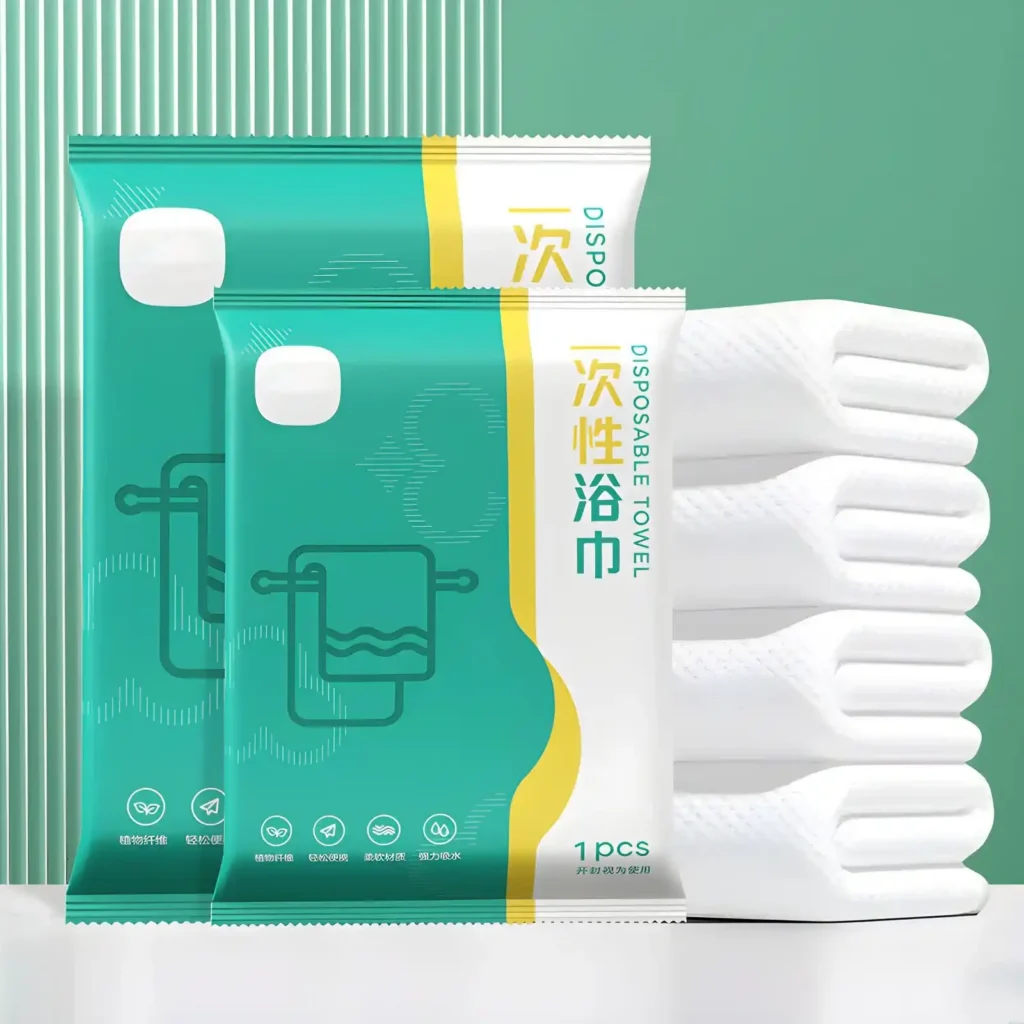
Disposable bath towels are becoming more common in hotels, spas, travel kits, healthcare settings and personal care retail packs. They look simple as a finished product, but producing them consistently requires close coordination between the folding stage and the packaging stage. A buyer evaluating this type of line should look beyond the towel size and ask how the material is controlled from roll feeding through final pillow packaging.
The first issue is raw material behavior. Disposable bath towels are usually made from non-woven fabric, dust-free paper, PE-composite materials or similar roll-fed substrates. These materials can be wider and bulkier than wipes or facial towels. Because of that, the unwinding system, tension control and web alignment have a direct effect on finished towel appearance. If the roll feed is unstable, the downstream fold will drift and the package will not look square.
Bath towel folding is also different from small wipe folding. The width direction often uses a fan-fold pattern with multiple layers, while the length direction may use repeated half-folding to bring the large sheet into a compact retail size. The number of folds should match both the unfolded towel size and the required package dimensions. Too few folds can create an oversized pack; too many folds can make the towel too thick and difficult to wrap cleanly.
A practical specification discussion should include unfolded size, folded size, material gsm, roll width, roll diameter and the final pack count. In many cases, a factory wants an individually wrapped towel for hospitality or travel use. That means the folded piece must move smoothly from the folding machine to a horizontal flow-wrapper or pillow packaging machine. Transfer stability is just as important as folding speed.
Cutting accuracy is another key point. Large disposable towels need a clean, repeatable cut so the final edges look consistent after packaging. Servo-controlled cutting and photoelectric positioning can help keep tolerance under control, especially when the product length changes between towel sizes. Buyers should ask whether the quoted tolerance applies to their target material and finished length, not only to a standard sample.
Packaging has its own constraints. A pillow-style wrapper forms film around the folded towel, seals the pack lengthwise, seals both ends and cuts individual packs. If the folded towel is too high, too soft or unevenly stacked, sealing quality can become unstable. The packaging machine should be selected together with the folding machine so that speed, product height and pack size are aligned.
Factories should also consider how much adjustment will be required between SKUs. A towel line may need to produce different formats for hotels, spas, airline amenity kits or retail travel packs. Changeover points include material width, folding layers, cutting length, film width and sealing temperature. A line that is easier to adjust may deliver more real output than a faster machine that takes a long time to reset.
For a detailed technical reference, ZXJ Machinery explains the complete process in its guide to disposable bath towel manufacturing, covering the folding machine, fan-fold pattern, pillow packaging stage and typical buyer requirements. It is a useful checklist for companies comparing bath towel production lines or planning a new disposable towel product.
The best production line is not simply the one with the highest speed number. It is the line that keeps large-format material under control, folds it into a stable shape and moves it into packaging without manual correction. When folding and wrapping are specified as one system, disposable bath towel production becomes more predictable, cleaner and easier to scale.
Paul Ton
.