Pizza Box Dimension: Standard Sizes, Measurements & Uses
One of the most popular foods all over the world is pizza, and it is important to use the appropriate packaging for such a popular meal. Choosing the correct pizza box dimension helps restaurants protect themselves as it will allow protecting their products from any damage, will ensure good delivery, and will contribute to a nice appearance of the product. If the restaurant sells personal or big family portions of pizza, the appropriate packaging will make a great difference.
Why Does the Pizza Box Dimension Matter?
The size of a pizza box has a significant impact on the safe transit of the pizza from the restaurant to the consumer. The appropriate size of the box gives enough room for the crust and toppings while not allowing for any movement.
Too small boxes may harm the crust and the pizza itself. In contrast, too big boxes will cause the pizza to move inside while being transported. Both situations may lead to customer dissatisfaction.
Appropriate packaging brings about the following advantages:
Improved protection: appropriate packaging will protect toppings and crust.
Enhanced appearance: proper packaging will keep the pizza looking good.
Easy transportation: appropriate packaging makes stacking and transporting easier.
Reduction of packaging waste: appropriate sizing saves cardboard.
Customer satisfaction: appropriate packaging ensures the quality of the food.
Hence, packaging sizing is one of the aspects of food delivery.
Standard Pizza Box Dimension Chart:
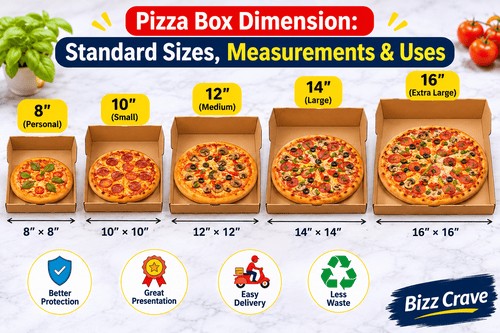
Pizza boxes are available in different sizes to accommodate various pizza diameters. Most suppliers offer small, medium, large, and extra-large options. However, measurements can vary depending on the manufacturer, cardboard thickness, and box design.
Here is a useful reference chart:
Pizza Size
Approximate Box Base
Common Use
8 inches
8 × 8 inches
Personal pizza
10 inches
10 × 10 inches
Small pizza
12 inches
12 × 12 inches
Medium pizza
14 inches
14 × 14 inches
Large pizza
16 inches
16 × 16 inches
Extra-large pizza
18 inches
18 × 18 inches
Family pizza
These are nominal reference measurements, not universal internal specifications. Some manufacturers provide additional clearance or use slightly different external measurements.
Restaurants should always check the usable internal space before ordering packaging in bulk.
Different Types of Pizza Packaging:
The packaging industry offers several options for restaurants. Each type has different features, advantages, and practical uses.
Standard Square Pizza Boxes:
Square cardboard boxes are among the most familiar packaging choices. Their flat base provides support, while the folding lid protects the pizza.
These boxes are available in different sizes and are suitable for takeaway and delivery orders. They also stack conveniently, making storage easier for restaurants.
Corrugated Pizza Boxes:
Corrugated cardboard contains a fluted layer between paperboard sheets. This construction provides additional strength and support.
Restaurants may choose corrugated packaging when they need stronger boxes for transportation. The material also helps maintain the structure of the packaging.
Custom Printed Pizza Boxes:
Custom packaging allows businesses to display their logos, brand colors, promotional messages, and contact information.
An attractive design can create a professional appearance and help customers recognize a restaurant. However, businesses should select suitable printing materials and ensure that the packaging meets food-contact requirements.
Eco-Friendly Pizza Boxes:
Many businesses are becoming interested in environmentally responsible packaging. Recyclable cardboard and appropriately sourced paper materials can offer useful alternatives to certain conventional packaging options.
Restaurants should check local recycling facilities and the manufacturer’s material information before making environmental claims.
How to Choose the Right Pizza Box Dimension:
Choosing the right packaging is not just a matter of observing the size of the pizza that is being advertised. There are several considerations that restaurants need to make.
Measuring the Size of the Pizza:
In the first place, measure the pizza from one edge of the crust to another across the center of the pizza.
It is advisable not to take measurements on the basis of dough alone since the pizza can expand in the process of cooking.
Thickness of the Pizza:
Thin-crust and regular pizzas will have no problem fitting into the boxes while deep-dish or stuffed-crust pizzas may need some extra height.
Checking Internal and External Dimensions:
A common error is to think that the external dimensions of the box correspond to the internal available dimensions.
The dimensions can be affected by cardboard thickness and construction method. You should always request the internal length, width, and height from the provider.
Consider Delivery Requirements:
Restaurants should take into consideration how the boxes will fit in delivery bags, shelving systems, and transport containers.
Boxes with good dimensions are easier to handle and minimize movement during transport.
Comparing Packaging Quality:
Although cheap packaging seems to be an interesting option, it could cause you some trouble. Compare cardboard quality, folding method, food compatibility, and waterproofness.
Common Mistakes to Avoid When Selecting Pizza Boxes:
Even seasoned restaurant owners can make mistakes when packaging their food. Proper care will ensure good presentation and no unnecessary spending.
Use of an overly small box: The small box can squeeze the crust and spoil the toppings.
Not considering the height of the box: The insufficient height can cause difficulties with packing thick pizza.
Using low quality cardboard: Packaging that is of low quality can collapse.
Forgetting the dimensions of the manufacturer: Various manufacturers can measure the box inside and outside differently.
Ordering large quantities without testing:Bulk buying can cost a lot of money if the chosen box does not fit the product.
Good measures can prevent all these problems.
How Better Packaging Improves Restaurant Branding:
Not only does packaging serve as a protective shield for a product, but it also serves as a chance for advertising a food business.
The neatness and beauty of the pizza box can help make a good first impression even before the box is opened by the customer.
Businesses can design, print information, and even incorporate colors that help enhance their brand image.
Contact information such as a website, social media account information, and phone number can be incorporated into the packaging as well.
To learn more interesting information about business, packaging, and digital marketing, visit Bizz Crave.
Conclusion:
The choice of the proper pizza box size is crucial not only for restaurants but for takeaway firms and companies engaged in food packaging. Proper sizes of pizza boxes serve protective functions and provide the possibility to present pizza in an appealing manner.
Each option of packaging from small individual packaging to big family one should correspond to the real size and thickness of pizza as well as the conditions of transportation. Business owners need to pay attention to such aspects as the quality of cardboard, inner measures and brand design.
Instead of choosing packaging according to its cost, it is better to consider its sizes and quality.
FAQ’s:
What are the standard dimensions of pizza boxes?
Standard nominal dimensions include 8 × 8, 10 × 10, 12 × 12, 14 × 14, and 16 × 16 inches. Actual dimensions may vary from one manufacturer to another.
What box size is ideal for a 12-inch pizza?
The standard nominal size of a box for a 12-inch pizza is usually 12 × 12 inches. However, the inner dimensions of the box need to be taken into consideration as well.
What is the importance of box height in pizza boxes?
Box height is the distance available between the bottom of the box and the top of the lid. It helps in providing sufficient clearance for crust and toppings.
What is the material used to make pizza boxes?
Common materials used are corrugated cardboard and paperboard. The material will depend upon its strength, design, and food packaging requirement.
How can restaurants select appropriate pizza box sizes?
Restaurants should measure the baked pizza, check internal box dimensions, consider pizza thickness, and test packaging before purchasing in bulk.
Clara Whitmore
.