Aseptic Packaging Market to Reach $51.5 Billion by 2034 as Shelf Life Becomes a Supply-Chain Asset
PUNE, INDIA- September 2026- Aseptic packaging is increasingly moving beyond its traditional role as a packaging format and emerging as an integrated technology platform connecting product preservation, barrier materials, filling systems, logistics and supply-chain economics, according to new analysis from Prismane Consulting.
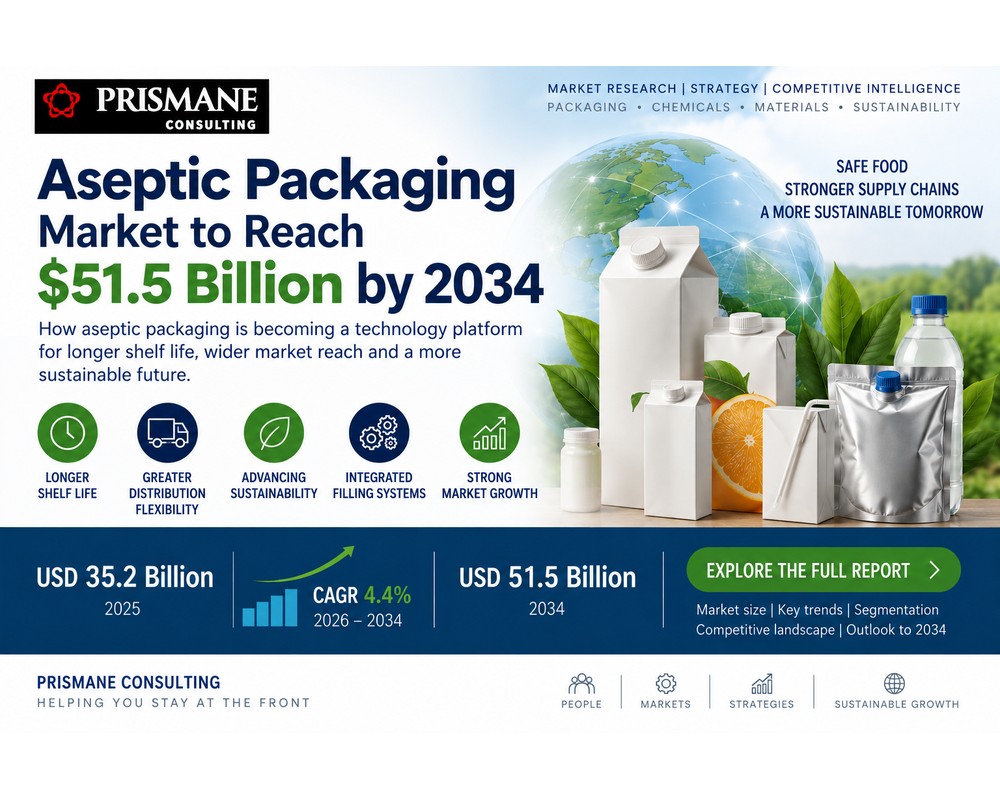
Prismane Consulting estimates that the global aseptic packaging market was valued at USD 35.2 billion in 2025 and is projected to reach USD 51.5 billion by 2034, representing a CAGR of approximately 4.4% during 2026–2034.
The market’s growth is being supported by the continuing importance of extended shelf life, product protection, convenience and distribution flexibility across food and beverage applications.
Shelf Life Is Becoming a Supply-Chain Asset
The strategic value of aseptic packaging increasingly extends beyond the package itself.
For suitable products, extended shelf life can support broader geographic distribution, improve inventory flexibility and reduce product losses. Where ambient distribution is technically appropriate, aseptic packaging can also reduce dependence on continuous refrigeration across selected stages of the supply chain.
This makes shelf life an increasingly important consideration in packaging and supply-chain strategy.
Manufacturers can potentially use longer product usability to support centralized production while serving geographically dispersed markets. The resulting benefits can influence warehousing, transportation, inventory planning and market accessibility.
Barrier Performance Remains Critical
Aseptic packaging structures must protect products from oxygen, moisture and light while maintaining package integrity and compatibility with industrial sterilization and filling systems.
Conventional aseptic carton structures have typically relied on combinations of paperboard, polymer and aluminum foil to achieve the necessary balance of rigidity, sealing and high-barrier performance.
However, sustainability targets and evolving packaging regulations are encouraging the industry to explore lower-complexity structures, thinner functional layers and alternative barrier technologies.
The challenge is maintaining product protection and shelf life while improving the package’s end-of-life profile.
Sustainability Is Becoming a Structural Challenge
The sustainability transition in aseptic packaging is not simply a matter of replacing one material with another.
Paperboard, polymers and barrier materials each perform specific functions within the package. As a result, improving recyclability requires packaging developers to consider the entire structure rather than focusing on a single material component.
Potential innovation pathways include reduced structural complexity, thinner barrier layers, alternative barrier technologies, optimized polymer structures, improved material separation and greater use of recycled content where technically and legally feasible.
The development of collection, sorting and recycling infrastructure will also play an increasingly important role.
Packaging and Filling Technology Must Evolve Together
Aseptic packaging innovation is closely connected to filling technology.
Changes in material thickness, stiffness, sealing characteristics or thermal behavior can affect package formation, sealing windows, dimensional stability and filling-line efficiency.
This makes commercial adoption dependent not only on laboratory barrier performance but also on compatibility with established sterilization and filling systems.
Greater collaboration among material suppliers, converters, filling-equipment manufacturers and food and beverage producers is therefore expected to remain important as the industry develops lower-complexity and more recyclable packaging structures.
Competition Is Expanding Across Packaging Formats
The aseptic packaging landscape is also becoming more diverse.
Alongside conventional aseptic cartons, flexible pouches, polymer-based containers, bottles and other rigid formats can support aseptic or extended-shelf-life applications depending on product and processing requirements.
As a result, competition is increasingly taking place between packaging architectures rather than individual materials.
The optimal format depends on the interaction between product sensitivity, required shelf life, barrier performance, filling technology, logistics and end-of-life infrastructure.
Prismane Consulting Perspective
“Aseptic packaging should increasingly be viewed as a system-level technology rather than simply a container,” said Prakhar Jain, Senior Consultant at Prismane Consulting.
“Packaging developers and food and beverage manufacturers will need to balance product protection, shelf life, filling efficiency, material intensity, logistics and circularity. The competitive advantage will increasingly come from integrating these requirements rather than optimizing a single packaging component.”
According to Prismane Consulting, the industry’s next phase of development will be shaped by the intersection of shelf-life economics, barrier technology, filling-line efficiency, sustainability requirements and recycling infrastructure.
The transition is unlikely to be uniform across applications. Products with demanding protection and shelf-life requirements will continue to prioritize food safety, package integrity and performance, while sustainability improvements will need to demonstrate compatibility with these requirements.
For companies operating across packaging materials, converting, filling equipment, food and beverages and recycling, these developments create opportunities as well as new technology and investment requirements.
Prismane Consulting provides market intelligence and strategic research covering packaging, paper and paperboard, polymers, chemicals and related industrial sectors. Its packaging research includes market sizing, demand and supply analysis, competitive intelligence, company benchmarking, value-chain assessment, technology analysis and market forecasting.
Read Prismane Consulting’s latest analysis of the global Aseptic Packaging Market to explore market size, growth, segmentation, competitive landscape and industry outlook through 2034: https://prismaneconsulting.com/blog-details/aseptic-packaging-market-in-2026-when-shelf-life-becomes-a-packaging-technology
Prakhar Jain
.