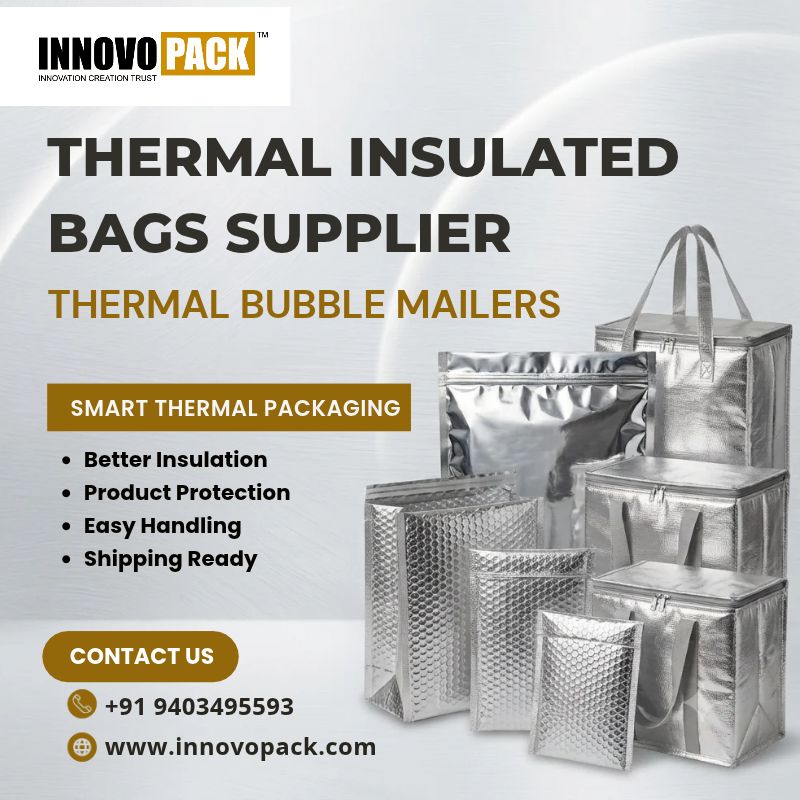
Thermal Insulated Bags Supplier for High-Quality Thermal Bubble Mailers
Find a reliable thermal insulated bags supplier offering quality thermal bubble mailers for protecting temperature-sensitive products during storage and transportation.
Temperature-sensitive products require packaging that can handle more than routine transportation. During shipping, products may move through warehouses, delivery vehicles, loading areas, and different climatic conditions. A reliable thermal insulated bags supplier can provide packaging designed to help reduce exposure to external temperature changes while maintaining practical handling and shipping requirements.
For manufacturers, distributors, e-commerce businesses, and other organizations, packaging is an important part of product protection. The right solution can help minimize unnecessary exposure to heat, cold, moisture, and physical handling while keeping the overall package lightweight and convenient.
The demand for insulated packaging has grown as businesses increasingly ship food, pharmaceutical products, cosmetics, specialty materials, and other goods directly to customers. These shipments may travel considerable distances before reaching their destination, making packaging selection an important operational decision.
Understanding Thermal Insulation in Modern Packaging
Thermal insulation works by slowing the movement of heat between the packaged product and its surrounding environment. The effectiveness of a packaging solution depends on several factors, including material construction, package size, outside temperature, transit duration, and the sensitivity of the product being transported.
It is important to understand that insulated packaging is not automatically a substitute for complete temperature-control systems. Instead, it can form one part of a broader packaging strategy. Depending on the application, businesses may combine insulated packaging with cold packs, gel packs, liners, or other temperature-management methods.
A well-planned packaging system should therefore be selected according to actual shipping conditions rather than relying only on general product specifications.
Why Businesses Use Thermal Bubble Mailers
Thermal bubble mailers offer a combination of thermal insulation and cushioning in a flexible mailer format. This makes them useful for businesses that need additional protection without moving to heavier or more rigid packaging.
The bubble structure can provide a cushioning layer against minor impacts, while the insulating construction helps reduce the effect of surrounding temperature changes. This combination is particularly useful in shipping environments where packages may be handled several times before final delivery.
Common advantages include:
Lightweight construction for easier handling
Additional cushioning during routine transportation
Insulating properties for temperature-sensitive products
Flexible design for convenient packing and storage
Suitability for a range of shipping applications
The actual performance required will vary depending on the product, route, and environmental conditions. Businesses should evaluate these factors before selecting a particular packaging format.
Applications Across Food, Pharmaceutical and E-Commerce Sectors
Insulated packaging has become relevant across several industries because products do not all respond well to uncontrolled environmental conditions.
Food businesses, for example, may use protective packaging for selected products that require additional thermal resistance during delivery. Online food brands and specialty food suppliers can benefit from packaging that is practical for order fulfillment and last-mile transportation.
Pharmaceutical and healthcare businesses may also require carefully planned packaging for products that are sensitive to temperature variations. In these situations, packaging selection should be based on the specific storage and transportation requirements of the product rather than using a one-size-fits-all approach.
Other potential applications include:
Cosmetics and personal-care products
Laboratory and research materials
Specialty chemicals
Selected electronic components
Temperature-sensitive e-commerce products
The appropriate packaging specification should always be determined according to the product characteristics and shipping conditions.
Selecting the Right Thermal Insulated Bags Supplier
Choosing a thermal insulated bags supplier should involve more than comparing prices. Businesses need a supplier capable of delivering consistent material quality, appropriate product dimensions, reliable supply, and solutions that match the intended application.
Before finalizing a supplier, procurement teams can evaluate factors such as:
Material quality and construction
Available sizes and formats
Customization possibilities
Production consistency
Order quantity requirements
Delivery capabilities
Technical support and product guidance
A supplier with a clear understanding of packaging applications can make the selection process easier. This is particularly important for businesses with repeat shipping requirements, where consistency from one order to the next can directly affect daily operations.
Packaging Design and Material Considerations
The design of insulated packaging influences how effectively it fits into a company’s existing packing process. A suitable package should protect the product while remaining practical for employees to assemble, seal, label, store, and dispatch.
Material thickness is one consideration, but it should not be viewed in isolation. Increasing material thickness may not always deliver the best overall solution if it creates unnecessary weight or storage requirements. Instead, businesses should consider the complete construction and intended application.
Dimensions are equally important. Packaging that is significantly larger than the product can increase material usage and leave unnecessary internal space. Packaging that is too small may make proper sealing difficult or compromise the protection of the contents.
For this reason, packaging design should be evaluated from both a protection and operational perspective.
How Thermal Bubble Mailers Support Efficient Shipping
Thermal bubble mailers can fit conveniently into shipping workflows where flexibility and low package weight are important. Their mailer-style format can make them easier to handle than some rigid packaging alternatives, particularly when businesses process a large number of shipments each day.
For e-commerce operations, packaging efficiency can influence both warehouse productivity and customer experience. Employees need packaging that can be prepared quickly without complicated procedures, while customers expect products to arrive in good condition.
Flexible insulated mailers can support these requirements by offering a practical packaging format that combines protection with convenient handling.
They can also be useful when storage space is limited. Compared with bulky rigid packaging, flexible formats may be easier to organize and store in a warehouse or fulfillment area.
Quality and Consistency Matter in Large-Scale Packaging
When packaging is purchased regularly, consistent quality becomes just as important as the initial product specification. Variations in dimensions, material construction, sealing performance, or overall finish can create difficulties for businesses managing high shipment volumes.
A dependable packaging partner should maintain appropriate quality-control practices throughout production. This helps businesses establish predictable packing processes and reduces the need to make frequent adjustments to accommodate inconsistent packaging.
For procurement teams, it is also useful to assess how a supplier handles repeat orders and customized requirements. A product may perform well during a small trial, but long-term supply reliability is what ultimately matters for businesses operating at scale.
Choosing Thermal Bubble Mailers for Specific Shipping Needs
Selecting thermal bubble mailers should begin with a clear understanding of the product and its journey. The same packaging may not be appropriate for every shipment, particularly when transit duration, climate, and product sensitivity differ.
Businesses should consider:
How sensitive the product is to temperature changes
Expected transportation time
Typical environmental conditions
Product size and shape
Required cushioning and protection
Whether additional cooling materials are needed
Testing packaging under realistic shipping conditions can provide valuable information before introducing it across a large order volume. Trial shipments can help identify practical issues related to packing, sealing, handling, and transportation.
This approach allows businesses to make packaging decisions based on actual requirements rather than assumptions.
Building a Reliable Packaging Strategy
Packaging should be considered as part of the wider supply chain. Product protection begins when an item is packed and continues through storage, transportation, handling, and final delivery. Each stage can introduce different risks.
Businesses that regularly ship temperature-sensitive products should therefore establish clear packaging standards. These standards can cover package dimensions, insulation requirements, sealing procedures, storage conditions, and handling instructions.
Working with an experienced thermal insulated bags supplier can also help simplify procurement and maintain consistency. A supplier that understands different applications can help businesses identify suitable packaging formats according to their operational requirements.
Rather than selecting packaging solely on cost, companies should consider the total value it provides. Better protection, easier handling, consistent quality, and efficient storage can all contribute to a more dependable shipping operation.
Making a Practical Packaging Choice
The best packaging solution is one that fits the product, transportation environment, and operational process. Businesses should look at insulation requirements alongside factors such as weight, durability, dimensions, storage, and ease of use.
For organizations handling temperature-sensitive shipments, thermal bubble mailers can provide a practical balance between thermal protection and convenient handling. When selected and used appropriately, they can become a useful part of a broader product-protection strategy.
Innovo Pack supports businesses looking for packaging options suited to different product and transportation requirements, helping them approach thermal packaging with greater clarity and confidence.
Effective packaging is about matching the solution to the real-world conditions a product will face. A thoughtful approach can help businesses protect products, improve shipping reliability, and deliver a better experience from the packing station to the customer.
Visit: https://www.innovopack.com/thermal-bubble-mailers-insulated-bags-supplier/
Contact: +91 9403495593
Innovo Pack