ATEX Explosion Proof Digital Camera UAE: Buyer’s Guide
ATEX Explosion Proof Digital Camera UAE: What Procurement Teams Should Check Before Buying for Zone 1 and Zone 2 Sites
A single uncertified camera brought onto an offshore platform can void an entire permit-to-work system. That is not an exaggeration — it is the reality facing procurement teams across the UAE’s oil, gas and manufacturing sectors, where a device with the wrong ingress rating or gas group can trigger a full site stand-down. As inspection, incident documentation and maintenance photography become routine tasks in hazardous areas, the humble camera has quietly become a compliance-critical asset. Buying the wrong one is not a minor procurement slip; it is a safety and legal exposure. This guide walks you through exactly what to check before you commit a budget.
Why Zone Classification Changes What You’re Allowed to Buy
Zone 1 and Zone 2 are not interchangeable labels on a spec sheet — they describe how often an explosive atmosphere is likely to be present. Zone 1 sites expect flammable gas or vapour during normal operation; Zone 2 sites expect it only under abnormal conditions. Your camera’s certification must match the zone it will actually enter, not the zone your site was classified as five years ago. Many UAE facilities have expanded or altered process lines since their original hazardous area study, and procurement teams sometimes buy against outdated zone maps. Before you request quotes, confirm the current classification with your HSE or process safety team, because an ATEX Explosion Proof Digital Camera rated for Zone 2 will not legally or safely operate in a Zone 1 environment.
Certification Checkpoints You Cannot Skip
Every hazardous-area camera purchase should be verified against a short but non-negotiable checklist. Skipping any one of these points is where most compliance failures originate.
ATEX Directive marking — confirms the device meets EU equipment requirements for explosive atmospheres, still the reference standard many UAE operators align with contractually.
IECEx certification — the international equivalent, often required for multinational oil and gas contracts operating across GCC and global sites.
Enclosure (IP) rating — determines resistance to dust and moisture ingress, critical for maritime and offshore deployments.
Gas group classification (IIA, IIB, IIC) — dictates which specific gases and vapours the enclosure is proven safe against.
Temperature class (T-rating) — sets the maximum surface temperature the device can reach, which must sit below the auto-ignition point of gases present on site.
Ask your supplier to provide the actual certificate, not just a datasheet claim. A camera described loosely as an ATEX certified Explosion proof Handheld Camera should come with a certificate number you can independently verify through the notified body’s public register.
Where UAE Buying Mistakes Actually Happen
Procurement failures rarely stem from ignorance — they stem from time pressure and assumption. Across Jebel Ali, Ruwais, Musaffah and Fujairah’s industrial clusters, three mistakes recur most often.
Assuming a “rugged” camera is automatically explosion-proof. Impact and drop resistance say nothing about spark or thermal containment.
Buying on price before confirming zone-specific certification, which forces a costly re-purchase once the safety team rejects the device on site.
Overlooking maintenance documentation requirements under DSEAR-aligned inspection regimes, where certificates must be traceable throughout the equipment’s operational life, not just at point of purchase.
Oil and gas operators offshore, maritime terminals handling bunkering operations, and manufacturing plants running solvent-based processes face different risk profiles, so a one-size-fits-all camera policy rarely survives an audit. Your permit-to-work documentation should specify the exact certification tier required before any device reaches the gate.
Comparing Ruggedness, Image Quality and Maintenance Without Overspending
It’s tempting to chase the highest resolution or the most rugged housing on the market, but overbuying wastes budget without adding safety value. Instead, match the camera to the actual task.
If your team primarily performs visual inspections and incident logging, prioritise reliable image clarity and battery life over cinema-grade optics. If the device will be handled by rotating shift workers, weigh ergonomic housing and drop tolerance more heavily than megapixel count. Maintenance overhead matters too — an Explosion proof hazardous area digital camera with modular battery packs and field-replaceable seals reduces downtime compared with sealed units that require factory servicing for every fault. Ask suppliers for total cost of ownership over three years, not just the purchase price, since recertification and servicing costs vary significantly between manufacturers.
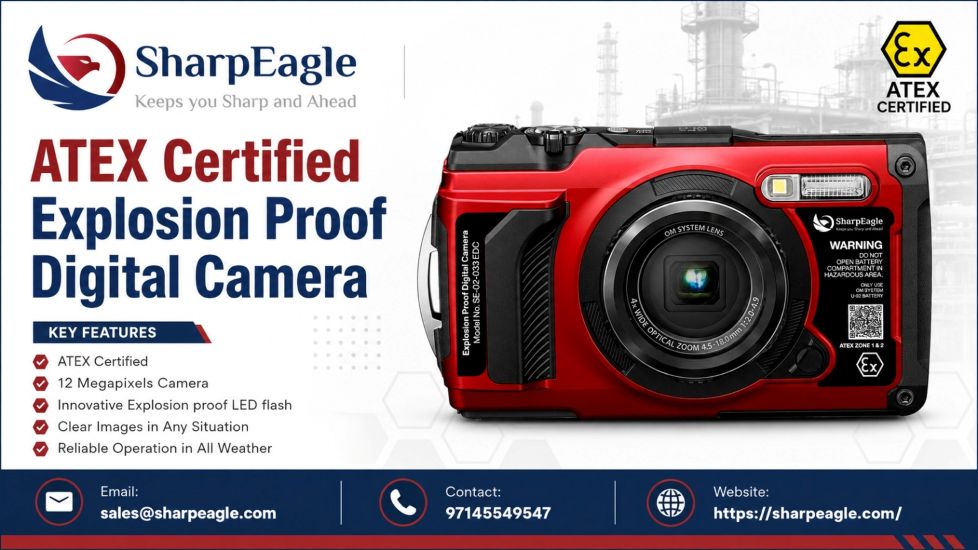
SharpEagle Explosion Proof Digital Camera
For procurement teams sourcing an ATEX Digital Camera for hazardous areas in the UAE, the SharpEagle ATEX certified Explosion Proof Digital Camera is built specifically around Zone 1 and Zone 2 field requirements. It combines verified ATEX and IECEx certification with a robust IP-rated enclosure suited to offshore, onshore and maritime deployment. Key strengths include:
Certified gas group and temperature class documentation supplied with every unit, simplifying audit trails.
A rugged housing designed for continuous handheld use by inspection and maintenance crews.
Reliable imaging performance for incident reporting, asset inspection and compliance photography.
Field-serviceable components that reduce the total maintenance burden across a facility’s device fleet.
As an intrinsically safe digital camera for oil rigs, gas plants and manufacturing sites, it is positioned as a practical, audit-ready choice rather than a specification overreach. Full technical details are available on the SharpEagle product page.
Closing Thoughts
Hazardous area equipment procurement in the UAE is only going to face closer scrutiny as HSE enforcement and DSEAR-aligned inspection practices mature across the region’s industrial base. Treating camera selection as a genuine safety decision, not an IT accessory purchase, protects your team, your site’s operating licence and your project timelines. Working with a proven ATEX Digital Camera Explosion proof supplier from the outset avoids costly re-procurement cycles later.
If your team is finalising a hazardous area camera specification, get in touch with SharpEagle Technology to confirm the right certification fit for your site.
About SharpEagle Technology
SharpEagle Technology is a leading provider of industrial safety solutions specializing in forklift safety systems, explosion-proof surveillance cameras, and AI-powered monitoring technologies for warehouses, logistics, manufacturing, and high-risk industrial sectors.
For more information, visit: https://www.sharpeagle.uk/
SharpEagle Technology
.