Why Rectangular Cosmetic Glass Bottles Need Different Conveyor Guide Settings
A rectangular cosmetic glass bottle may look stable when standing on a table. Yet that appearance does not guarantee smooth movement through an automated filling and packaging line.
The problem is not necessarily the quality of the glass. It is the relationship between bottle geometry and the equipment used to move and position the container.
Compared with a cylindrical bottle, a rectangular bottle introduces different contact surfaces, corners, and orientation requirements. These differences matter when setting conveyor guide rails, especially where bottles travel around curves, enter downstream equipment, or accumulate in close succession.
For packaging buyers and cosmetic product development teams, conveyor compatibility should be considered before approving a new bottle silhouette.
A Guide Rail Does More Than Keep Bottles on the Conveyor
Side guide rails help control lateral movement as bottles travel along a conveyor.
Their position, height, contact material, and adjustment method affect how containers move through straight sections and transitions.
A round bottle presents a continuously curved side surface. A rectangular bottle has broad faces, narrower sides, and corner transitions.
That means a change in orientation can change which part of the rectangular bottle contacts the guide rail.
A rail setting that works well with a cylindrical bottle should not automatically be treated as suitable for a rectangular one, even if their maximum body widths are similar.
Packaging equipment suppliers such as Nercon offer adjustable guide systems specifically to accommodate changes in container dimensions. Sidel also identifies shaped bottles as an application for automatic guide adjustment.
These systems demonstrate why guide position is an important setup parameter. They do not establish a universal rail setting for all rectangular glass bottles.
Why Bottle Orientation Changes the Contact Geometry
A rectangular bottle has more than one meaningful body dimension.
Its front-to-back depth may be different from its side-to-side width. When the bottle rotates, the effective space required between the guide rails can change.
Corners also matter.
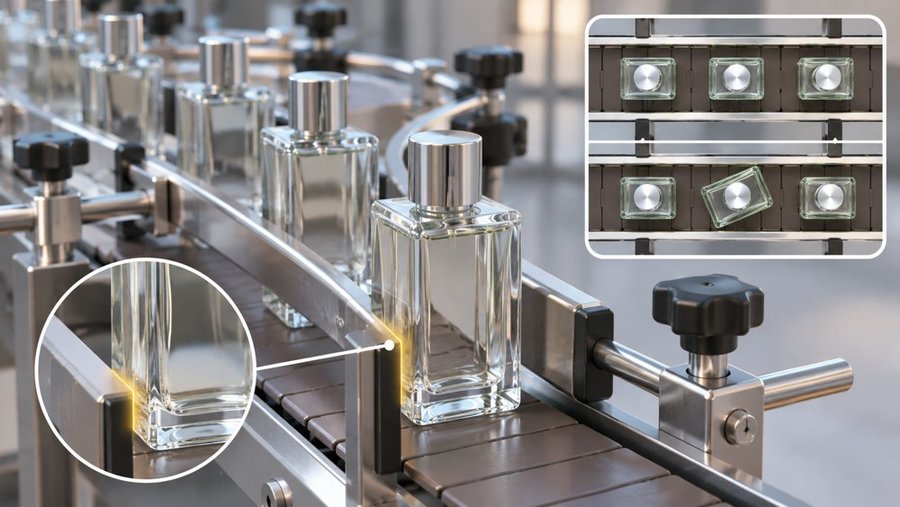
During a transition or a curve, a bottle corner may approach a rail before the broader face makes contact. If the guides are set too narrowly for that movement, the bottle may bind, rotate unexpectedly, or experience concentrated contact.
If the guides are too widely spaced, the bottle may move laterally or change orientation before reaching the next operation.
Neither situation can be evaluated from nominal capacity alone.
The relevant dimensions include body width, depth, corner radius, overall height, base geometry, and the location of surfaces likely to contact the rails.
For decorated bottles, the position of coatings, printed graphics, and labels may also influence where guide contact is acceptable.
Straight Sections and Curves Create Different Conditions
A bottle may move successfully along a straight conveyor and still behave differently at a curved section or transfer point.
On a straight path, the container may maintain a relatively consistent orientation.
At a curve, the direction of travel changes. Bottle-to-rail contact and the interaction between neighboring containers can change as well.
A rectangular bottle may tend to rotate, contact a corner, or become misaligned depending on the guide arrangement and the forces acting on it.
Transfers between conveyor sections introduce another consideration: the bottle’s base must remain adequately supported as it crosses the transition.
A guide-rail adjustment cannot compensate for every possible transfer or stability problem.
The line designer may need to consider rail geometry, support surfaces, transfer layout, conveyor speed, and the permitted accumulation conditions together.
This is why a successful straight-line trial should not be mistaken for approval of the entire conveying route.
Guide Height and Surface Contact Matter
Guide spacing is only one part of the setup.
The height at which a rail contacts the bottle can influence its movement.
A low contact point may interact with a thick glass base or lower-body contour. A higher contact point may meet a sloping shoulder, a decoration area, or another surface that is unsuitable for guidance.
The appropriate contact zone depends on the bottle’s shape, mass distribution, surface finish, and the actual conveyor arrangement.
Glass also introduces practical concerns about unwanted rubbing and localized contact. These should be assessed against the selected bottle and guide materials rather than assumed from appearance.
For a bottle with painted or printed decoration, the packaging team should identify which regions are intended to remain visually undisturbed.
The objective is not simply to make the bottle fit between two rails. It is to guide the container consistently without creating unnecessary contact risks.
What Buyers Should Confirm Before Changing Bottle Shapes
When a cosmetic brand changes from a round bottle to a rectangular one, the packaging and production teams should share more than the new bottle’s nominal capacity.
A useful handover includes five items:
1. A controlled bottle drawing. Provide the overall dimensions, body width and depth, corner geometry, base design, and relevant tolerances.
2. The intended orientation. Clarify whether the bottle must face a particular direction for filling, capping, labeling, inspection, or secondary packaging.
3. Decoration and contact zones. Identify surfaces where guide-rail rubbing or concentrated contact would be undesirable.
4. The actual conveyor route. Review straight sections, curves, transfers, accumulation points, and the entry to downstream machines.
5. Representative sample trials. Have the equipment operator assess the selected bottle on the intended line, including relevant speeds, orientations, and operating conditions.
This information makes the changeover discussion more specific and helps distinguish a bottle-design question from an equipment-adjustment question.
Where Glass Bottle Suppliers Can Contribute
Glass packaging manufacturers can support this process by supplying accurate container information and representative samples.
For example, FOLOVER PACK provides cosmetic glass bottle manufacturing, custom bottle development, surface decoration, and component matching. In projects involving a rectangular bottle, these capabilities can support discussions about the proposed silhouette, bottle dimensions, decoration placement, and sample availability.
The final decision about guide-rail settings, conveyor performance, and line validation remains with the filling company or equipment specialist.
A bottle supplier can help define what is being conveyed. The equipment team must confirm how that bottle will travel through the actual system.
A Sample That Stands Upright Is Not Yet Line-Approved
A rectangular glass bottle should be evaluated in the context of the complete packaging route, not only as an isolated object.
Its geometry may affect guide contact, orientation, and behavior through curves and transitions. Those conditions cannot be judged reliably from a product photograph or desktop sample alone.
Before approving a new bottle shape, the packaging team should confirm that the drawing, guide setup, and production-line requirements have been considered together.
The key question is not simply whether the bottle fits between the rails. It is whether the bottle can move consistently through the intended packaging process.
Image credit: Original AI-generated conceptual illustration prepared for this article; not a photograph of an actual production line or a validated equipment trial.
Andy
.