Print registration: why it drifts on a long run, and what to write into the specification
Registration is one of those things that looks like a machine setting and is actually a specification decision. When a printed web drifts out of register three hours into a run, the argument that follows is usually about the press. More often it is about what the specification asked for, and what nobody wrote down.
This is a practical look at the three tolerances that are usually bundled together under one word, what moves them during a run, and what belongs in the artwork and print specification before the job starts.
Three tolerances, not one
“Registration” is used for at least three different requirements, and they fail for different reasons.
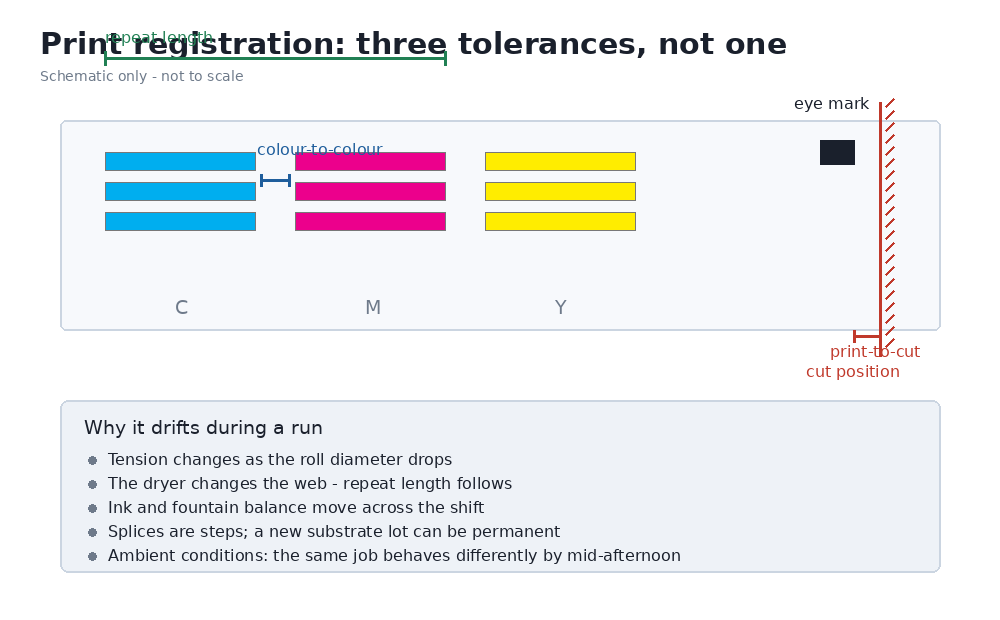
Colour-to-colour is the alignment of one printed colour against another. It is what people usually mean, and it is the tolerance most affected by web tension and by the stability of the press.
Print-to-cut is the alignment of the print to the final cut, whether that cut is a pouch profile, a label die or a bag seal position. It is defined by the eye mark and the cut sensor, and it decides whether the finished pack looks right. A print that is perfectly in register with itself can still be cut in the wrong place.
Repeat length is the distance between one impression and the next. It is set by cylinder or plate geometry and then changed by whatever the web does between printing units – most often by heat.
A specification that states one number for “registration” has not said which of the three it means, which is why the first disagreement has no resolution mechanism.
What actually moves it during a run
Most drift is not a sudden failure. It is a slow change, and it is usually one of these.
Tension changes as the roll unwinds. A full roll and a nearly empty one do not present the same load to the infeed. As the diameter drops, the tension control has to work differently, and small differences show up as a web that is a fraction longer or shorter by the time it reaches the last unit.
The dryer changes the web. Heat and solvent removal affect the substrate, and different substrates respond differently. A film that grows slightly in the dryer will change repeat length over the run, and the change is not necessarily linear from the start of the roll.
Ink and fountain balance move during the shift. As ink viscosity and water balance drift, the printed image can change dimensionally in small ways, and the effect accumulates across units.
Splices and lot changes arrive as steps. A splice is a momentary disturbance; a new substrate lot can be a permanent one if the new lot behaves differently from the old.
Ambient conditions change. A plant that is cool at night and warm by mid-afternoon will show registration behaviour that follows the same curve. This is one of the reasons a job that ran well on the night shift can behave differently on days.
None of these are operator errors. They are properties of the process, and the specification is where they should have been anticipated.
Tightening the tolerance costs something, and the cost is speed
This is the trade-off that is least often priced. Registration tolerance is not free: to hold a tighter window you have to narrow the variation in tension, temperature and ink behaviour. In practice that means running slower, making more frequent adjustments, or accepting more waste.
So a tolerance decision is a commercial decision. Asking for the tightest number the press can possibly hold, without asking what it costs, tends to produce a specification that is met on the sample and missed on the run.
The practical approach is to state the tolerance that the finished pack actually needs – driven by what the consumer sees and by what the filling line requires for the eye mark – and to say so in the artwork brief rather than leaving it to be discovered at the trial.
What belongs in the specification
- The three tolerances stated separately: colour-to-colour, print-to-cut, and repeat length.
- The measurement method for each, and where on the web it is measured – centre only, or across the full width.
- The substrate, its lot-to-lot dimensional behaviour, and what the press should expect from it.
- The position of the eye mark, and the tolerance the filling or converting line needs from it.
- Any element that must not move: barcodes, legal panels, and anything the customer scans or reads at a fixed position.
- The running conditions assumed – press, dryer settings, and the ambient range the plant actually experiences rather than the one on the datasheet.
- What is checked at the trial, and what is checked during production.
What better registration control will not fix
It will not rescue a design that places a critical element where the process cannot hold it. If a barcode sits near the edge of the repeat, or a legal panel is dimensioned to the tightest tolerance in the artwork, no amount of press discipline will make that robust across a long run.
It will not fix a substrate that changes between lots, because registration control cannot compensate for a material whose dimensions move differently than the last delivery did.
And it will not make a proof into a run. A proof is produced under stable, short-run conditions. It tells you what the job should look like; it does not tell you what the third hour of the shift will look like on a warm afternoon.
For more detail on how these tolerances are measured and reported, our technical library on flexible packaging specification sets out the parameters in full.
Image credit: registration schematic produced by J-Origin Packaging (own work).
Luna Luo, J-Origin Packaging
.