Barrier Specification for Flexible Packaging: An RFQ Checklist for OTR, WVTR and Light
Most barrier arguments between a brand and its packaging supplier are not disagreements about the film. They are disagreements about what the number on the specification sheet actually describes. Two converters can both quote “high barrier” for a comparable structure and both be correct, because the values were measured under different conditions. The purchase order then inherits the ambiguity, and it surfaces months later as a shelf-life failure that nobody can assign.
This is a checklist of what to nail down before the order, not after.
1. A barrier number without its test conditions is not a specification
Oxygen transmission rate (OTR) and water vapour transmission rate (WVTR) are not material constants. They are results, and they depend on the conditions of the measurement: temperature, relative humidity on each side of the sample, the test method, the sample area, and how long the sample was conditioned before the reading.
A WVTR quoted at 38 °C and 90% relative humidity is not comparable with one quoted at 23 °C and 50%. The same structure can differ by a large factor between the two. Neither number is wrong. They simply answer different questions, and only one of them answers the question your product will actually ask in the market it is going to.
So the RFQ should require, for every barrier value: the figure, its unit, the test method, the temperature, the relative humidity, and the thickness on which it was measured. A value missing any of those is not yet usable for a decision.
2. Normalised values hide which layer is doing the work
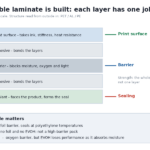
Barrier is often quoted normalised to thickness, which makes structures of different calliper comparable on paper. That is useful, but it can mislead, because barrier in a flexible laminate is not spread evenly through the structure. It is carried by one layer — an EVOH core, a metallised or coated film, or a foil — and the rest of the laminate is there for strength, sealing, printing and handling.
The practical consequence: adding calliper to the non-barrier layers will not move the barrier figure much, while damaging the thin barrier layer can destroy it. If the RFQ only specifies a normalised number, the supplier has latitude to reach it with a structure that behaves differently on the line and in the field. Ask which layer provides the barrier, and ask what happens to the figure if that layer is creased.
3. The film passes and the pouch fails
Barrier is normally measured on a flat specimen. A finished pack is not flat. It has seals, corners, gussets and folds, and it is handled. A laminate that meets its film-level specification can still fail shelf-life as a pouch, because the weakest point in a finished package is usually a seal or a fold, not the web.
If the product’s shelf life depends on the barrier, the RFQ should ask for testing at finished-package level as well as film level, and should say which of the two the acceptance criterion applies to. Film-level data is a material check. Package-level data is the one that predicts the shelf.
4. Flexing, creasing and pinholes
Thin barrier layers are fragile in a way that does not show up in a flat test. The web is folded over rollers, pulled through tension zones, formed into a tube, filled, sealed and then packed into a carton. Every crease is a mechanical event applied to the layer that carries the barrier.
Where a package will be handled hard, shipped in a constrained carton, or stored under load, it is reasonable to ask for flex-durability evidence — a flex or gelbo-style test followed by a barrier measurement — rather than a single as-made figure. This is one of the few cases where a lower headline barrier number on a more durable structure is the better commercial choice.
5. Light is a separate specification
OTR and WVTR say nothing about light. If the product is light-sensitive — oils, dairy powders, some snack seasonings, anything with a photo-labile colour or flavour — then light protection is its own requirement, met by an opaque or metallised layer, by pigment, or by the printed design.
A transparent high-barrier film can still be the wrong film for a light-sensitive product, and no amount of oxygen barrier will compensate. If light matters, the RFQ needs a light transmission or opacity requirement, and it needs to say whether it applies to the whole pack or to a window.
6. What to put in the RFQ
- The product, its water activity or fat content, and the target shelf life in weeks or months.
- The distribution route: climate, time in transit, storage temperature and humidity.
- Barrier requirements stated as value, unit, method, temperature, relative humidity and reference thickness.
- Whether the acceptance criterion is film-level, package-level, or both.
- A light transmission or opacity requirement, if the product is light-sensitive.
- Handling and distribution severity, and whether flex-durability evidence is required.
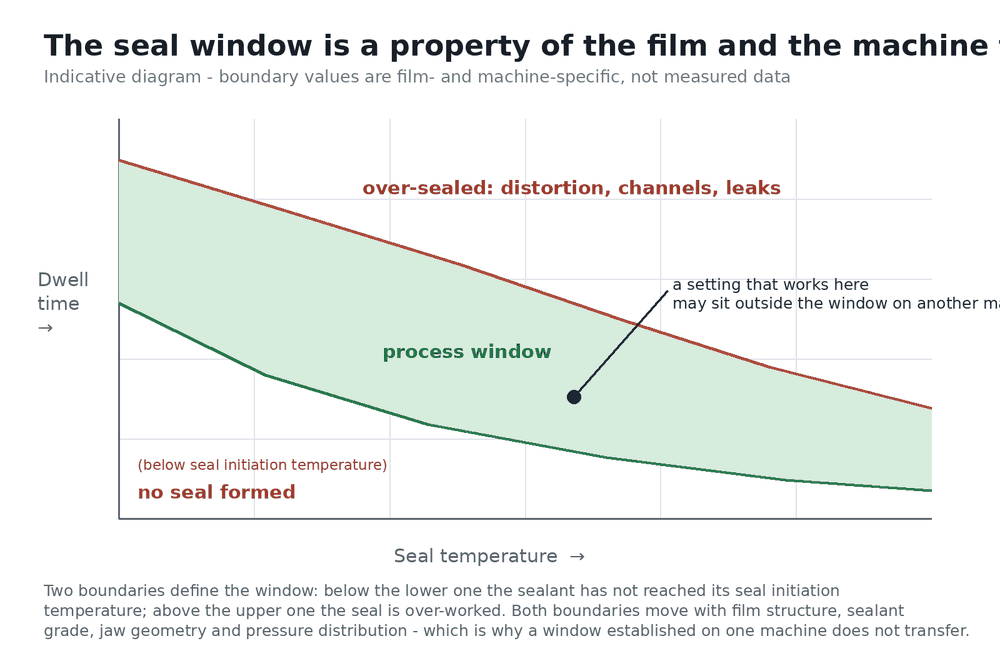
- The seal specification, since the seal is usually the limiting feature of the finished pack.
7. What a better barrier will not fix
A higher barrier will not rescue a pack that leaks through a contaminated seal, and it will not compensate for a distribution route hotter or more humid than the conditions the specification was written for. It also will not fix a product whose problem is headspace oxygen at filling rather than ingress afterwards. Each of those has its own answer, and specifying more barrier is not one of them.
For a more detailed treatment of how test conditions map to product risk, our [technical library on flexible packaging specification and testing](https://www.joriginpackaging.com/flexible-packaging-barrier-specification-otr-wvtr-test-conditions-product-risk-mapping/) sets out the conditions and the reporting fields in full.
Image credit: seal-window diagram produced by J-Origin Packaging (own work).
Luna Luo, J-Origin Packaging
.