Silica Gel Packets vs Molecular Sieve Packets – Which One Is Better?
Moisture is one of the most common threats in product packaging. It can corrupt the products even before they reach the end consumer, and that is what makes it one of the biggest threats in the product manufacturing industry. The use of dessicants is the easiest way for manufacturers to avoid spoiling the product.
Two options that currently dominate the market are silica gel packets and molecular sieve packets. Both are trusted products that are widely used in various industries. But they are not interchangeable, and picking the wrong one has real consequences for product integrity and shelf life.
Understanding the process of Silica Gels
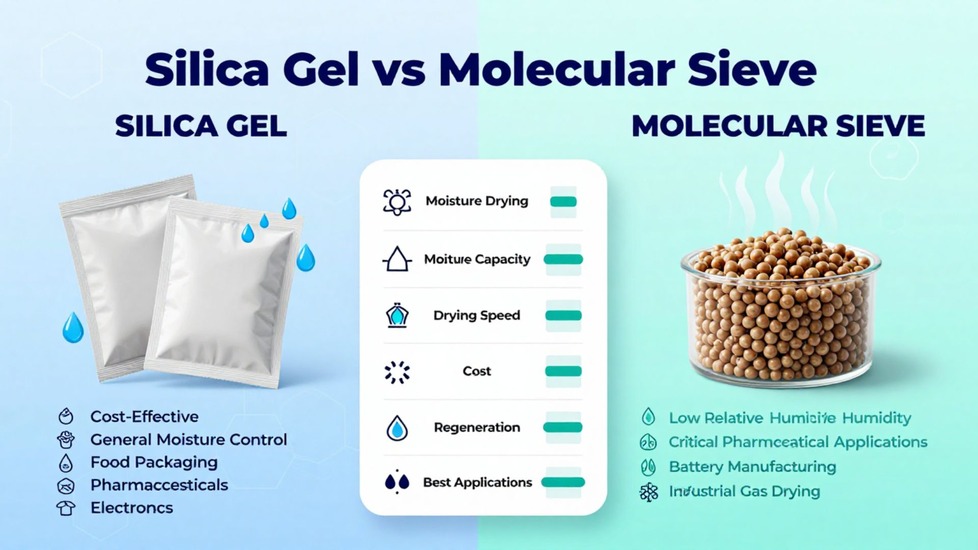
Silica gel is processed silicon dioxide. Its surface is covered in tiny pores that pull water vapor from the surrounding air and hold it. A standard packet can absorb up to 40% of its own weight in moisture and bring the relative humidity (RH) inside a sealed package down to roughly 40% RH.
Industries where silica gel is widely used are:
• Food packaging
• Leather goods and fashion
• Electronics
• Pharmaceuticals
• Industrial parts
Restrictions on using the silica gel packs:
• When the products are stored in areas below 20% RH, the absorption capacity drops sharply. It is not built for ultra-dry environments.
• If temperatures rise during shipping, absorbed moisture can come back out.
• Some products need RH levels that silica gel cannot reach.
How Molecular Sieves Work?
Molecular sieves are synthetic crystalline materials called zeolites. They have a perfectly uniform pore structure measured in angstroms. That uniformity gives them their edge over other options.
The two types most commonly used in packaging:
• 3A molecular sieves: It has a 3-angstrom pore size, built to capture water molecules while keeping larger molecules out
• 4A molecular sieves: This one has slightly wider pores, capable of adsorbing water and a broader range of small molecules
At 20% RH, molecular sieves absorb up to 22% of their weight in water. Silica gel manages 10-15% under the same conditions. As the humidity drops further, that gap is obviously more. Their crystalline structure also binds water tightly enough that temperature swings during transit do not push moisture back into the package.
Where molecular sieves do the job better:
• Pharmaceuticals
• Food and nutraceuticals
• Diagnostics and medical devices
• Electronics and precision instruments
• Specialty chemicals
Limitations:
• They cost more upfront.
• Over-desiccation is a real risk. Drive RH too low in a bottle of gelatin capsules, and you end up with a brittle product. Sizing the packet correctly is not optional.
Which One Do You Actually Need?
How moisture-sensitive is your product? If even a small amount of mixture can damage your product, then the obvious answer is molecular sieve. However, if moderate moisture will not spoil the product, then you can make do with silica gel packs. It is best to understand the effects of moisture on the product with the help of the product engineer before you make a choice.
What does your supply chain look like? Products moving through tropical climates, uncontrolled warehouses, or multi-leg international freight face real humidity and temperature variation. Since the supply chain is inevitable, it is best to go ahead with the sieves, even if it brings your cost up by a marginal percentage. The end consumer will thank you for a great product.
What are the unit economics of getting it wrong? Silica gel is cheaper per packet. For high-volume, low-margin products, that gap can make a lot of difference. For high-value items, the difference in desiccant cost per unit is negligible compared to the cost of a damaged or rejected shipment.
Using A Combination Of Both
For demanding applications, a dual-layer approach is the best way to keep the longevity of the product. Silica gel handles the outer layer, absorbing bulk ambient moisture quickly. Molecular sieve sits on the inner layer, holding RH at a precise low level.
Before You Finalize Your Choice
The desiccant type is just the starting point. The packet size, quantity, and format, pillow pak, unit pak, or canister, all determine how well it performs inside your actual container volume.
Adsorbtek Solutions offers FDA-approved silica gel and molecular sieve desiccants across pillow pak, unit pak, and canister formats, serving pharmaceutical, food, industrial, and specialty packaging applications. Visit adsorbteksolutions.com to explore their product range or reach out for sizing guidance.
Adsorbtek Solutions
.